
There’s a war of self-indulgence blasting on social media that’s causing your friends and followers to fall away…
“Heads-up!!!! people!!!! Dropping Facebook peeps who don’t respond to this cut-n-paste update.”
“Another day of the world hating me.”
“Dropping Trump supporters on my FB friends list.”
“Muting Clinton supporters on my Twitter feed #byefelicia”
“Ten years ago today my goldfish Goliath floated to the top of the bowl.”
Social media has become anything but social. It’s an online muddy battleground where few sprouts of positive growth spring. That was my dismayed belief for several years until recently one month I noticed on my Facebook newsfeed a longtime friend of mine posting daily posts that include the following examples:
“I am grateful to anyone who had to clean up my mess.”
“I am grateful for all the good good friends I have made and known over the many years and wish I could see more of every one of you.”
“I am truly grateful for the chance to entertain as many people as I have in my career and grateful to have helped anyone I have ever been lucky enough to help.”
“I am grateful for antibiotics, anesthesia and the widespread use of soap.”
“I am so grateful to my parents for all the sacrifices and beautiful labors they endured and I never thanked them for. Childhood is entitlement and parenting is responsibility.”
“I am grateful for avocados.”
Paul Romero, an actor I truly call ‘friend,’ is the author of the above ‘grateful posts’ and many more like them.
Each day Facebook algorithms placed the grateful posts in my newsfeed because Romero’s grateful posts garnered more ‘likes’ and comments. Many of his other posts I found on his Facebook page never appeared in my Facebook newsfeed. They didn’t generate enough ‘likes’ or comments for Facebook algorithms to deem each worthy of attention.
I was curious as to the why of Romero’s grateful posts and the reaction generated. When I inquired Romero responded:
“I was in a job I wasn’t very happy with or proud of, and it presented me
[only] a single day-off in two months. During that single day-off I moped around how I only had one day-off and had to go back to work, and how hard it was for me that I had pissed away two-thirds of the day and it suddenly occurred to me I had pissed two-thirds of my only day off I really ought to try to look at things from a different perspective. I came to the conclusion the thing to do was to look at the things I was grateful for. Not waste my time pitying myself or thinking how hard things are for me. So I decided to kick it over and look to something everyday that I was grateful for; to remind myself that things aren’t really that bad.”
Romero’s seasonal job was financially rewarding but left his creativity in debt. He re-examined how his artistically bereft employment, and his career in general, affected his online relationships.
“I have about 800 friends,” Romero said of his Facebook friends. “If I post something [career related] 10 – 20 people might chime-in.”
That’s a low ‘interest number’ for Facebook algorithms. Low interest posts with few ‘likes’ and/or comments or shares signals to those algorithms to not re-distribute the poor performing post to the newsfeeds of others. Same happens on Twitter and Linked-In. But Romero noticed a difference with his grateful posts. With a newly found objective to view his life more positively posting daily grateful posts Romero was surprised the response his grateful posts generated.
“I’m amazed at the [large] amount of attention that activity garnered,” he said. “My grateful posts generated 50 – 100 people being involved.”
The ratio of ‘likes’ to comments was vast. Possibly because Facebook users prefer to ‘like’ a post rather than place a comment. A ‘like’ involves less interaction. Facebook users find annoyance receiving notifications to a post on which they commented. Romero noticed this. “I roughly get 10% comments the rest are likes,” he noted.
Did any of Romero’s grateful posts generate a larger response / audience from his Facebook friends? Several did.
“Being grateful,” Romero began, “for the friendship for the friends that are already gone, and being grateful for the opportunity to entertain people in the many, many ways I can entertain people. And being grateful to my parents for the education and the support that they have given me. Those are the three posts that got the most attention.”
But did the positive posts generate new Facebook friends? Did being positive grow his audience?
“As a marketing tool it’s essentially insular,” Romero believes. “You’re only reaching people that are already in your ‘data base’ for lack of a better word. It [the grateful post] doesn’t encourage activity outside of your present world. It does raise your attention with people who are already there. It’s a good way to shake hands within your world but I don’t think anybody new comes tripping across unless people in your world are sharing-out [your] posts.”
Romero was keeping the interest of his audience; his friends.
People who utilize Facebook as a marketing tool can overlook the personal value of social media. Social media is not exclusive to generating new ‘friends’ or followers. Social media as a marketing tool is about keeping those who already follow you. And Romero has keen insight on who people on Facebook value or discard. In such, he sees others on Facebook utilizing the platform that is disdainful to him and likely just as unappealing to most Facebook users.
“There’s nothing that annoys us most than the things that we embody that we dislike in ourselves,” Romero began on what troubles him mostly about societal usage of Facebook. “People’s need to ask for other people’s attention, and pity because they’re having a bad day. Or because something bad has happened to them. Or just because they stubbed their toe. I think I was that person when I initially came on Facebook so I try very hard never to be negative. The converse of that is the thing that annoys me most professionally on Facebook is people who use Facebook purely as a tool to promote themselves without ever expressing themselves in any way. I certainly am as guilty as anyone using Facebook to promote myself especially when I’m working to direct traffic to my career. Facebook is useful to getting 10 or 12 people to any play that I do which is small potatoes but is useful. But I am offended by people that promote through Facebook and don’t ever have an actual dialogue on it.”
A lesson this author knows well. I intersperse my social network posts of career promotion with posts that offer information of benefit to those who asked to, or voluntarily, joined my platform(s). The vast majority of my ‘friends’ and followers on Facebook, Twitter, and Linked-In found me so as to possibly leverage my position in entertainment for their benefit. I don’t begrudge their intent. But I don’t fool myself as to what is reality and what is career promotion. Romero has a clear view on this situation as well.
“I deliberately attempt to be sincere as opposed to having another agenda,” Romero said. “If my sincerity causes people to gravitate towards me that’s great. It was important to me because of the reason I started the project [is] that all the posts be legitimately ‘grateful.’
“I could post that, ‘I’m grateful that The Oldcastle Theater cast me as Big Daddy’ and tag all the individuals that were a part of that and that would be a much more savvy choice than trying to open my arms up to the world.” But Romero knows in his heart that some may view honesty as self-promotion.
Did Romero’s grateful posts inspire his social media friends to follow in his digital footsteps?”
“F*ck yeah!” he said. “There are people who shared-out. And then there are people who picked up the ball and ran with it on their own… and are continuing to post grateful posts. It’s fascinating to me the worlds from which people came out of to say that they liked something. You would think that if the [post] was particularly appropriate to them in some way whether it was career orientated or youth orientated, or family orientated, then you would get a higher proportion of people from those worlds that were involved but the truth is I was amazed at names I had probably forgotten on my friends lists who were jumping on. In the spirit of fair play I tried to reach out to those people whenever they showed up [in response to a grateful post] and say “Hey! Thanks for saying ‘hello.’ I’m saying ‘hello’ back” because the weird identified anonymity of Facebook is a strange thing to me.”
Romero’s saying ‘hello’ back is the ‘social’ that social media has steamed rolled flat. The perceived usage of social media’s platform is to focus us on the “I” and not so much the “we.” The digital world needs more “we” than “me.”
Will Romero continue his positive ‘grateful’ posts?
“I’ve decided I’m going to continue in a less formal fashion for as long as I’ve something to be grateful for,” he said. “I assume I’ll find three or four times a week something that I’m grateful for and that life ain’t so bad.”
Share this:
Casting Directors, Talent Agents, Directors & Actors
Love Paul Russell’s Best-Selling Book for Actors
ACTING: Make It Your Business!
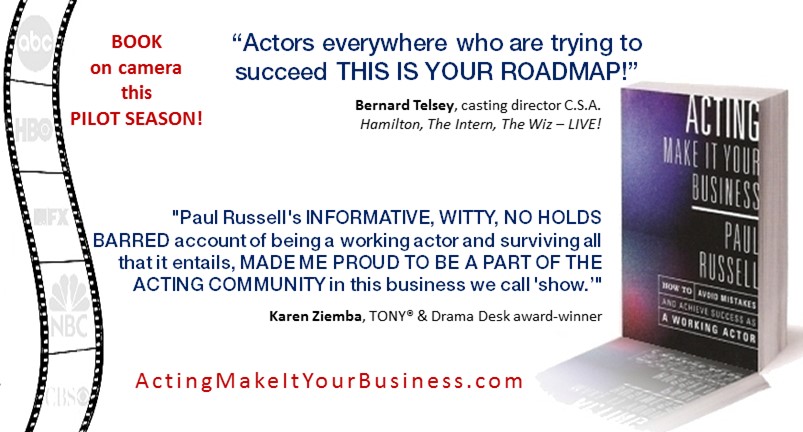
“Humorous and witty…
Actors everywhere who are trying to succeed in the business, young or old, on stage or on camera, anywhere in the world, take note:
This is your roadmap!”
— BERNARD TELSEY, casting director – CSA
(The Intern, Hamilton, NBC’s The Wiz – LIVE!, Wicked)
“All the right questions asked and answered…
and with a generous portion of good humor.”
— SUZANNE RYAN, casting director, CSA
(Law & Order, Unforgettable)
“I love this book!
Paul’s book tells you what you don’t want to hear but really need to know
EVERY actor should read this book!”
— DIANE RILEY, Senior Legit Talent Agent
Harden-Curtis & Associates
“Paul’s book made me proud to be a part of this community we call ‘show!'”
— KAREN ZIEMBA, TONY & Drama Desk Award Winning Actress
“Paul Russell’s words are not only blunt & accurate they zero in on all the questions every actor wants to know but is afraid to ask!”
— KEN MELAMED, Talent Agency Partner
Bret Adams, Ltd.
“I had my Business of Acting, BFA Seniors, class do book reports on a variety of “business of acting” books and ACTING: Make It Your Business came out a clear winner—considered to be essential for their bookshelves!
— Dr. NINA LeNOIR,
Dept. Chair – Dept. of Thtr.
Chapman University
Get smarter on the business of acting from legendary Hollywood & Broadway actors and talent agents in a casting director Paul Russell’s Best-Selling Book ACTING: Make It Your Business!
Paul Russell’s career as a casting director, director, acting teacher and former actor has spanned over thirty years. He has worked on projects for major film studios, television networks, and Broadway. Paul has taught the business of acting and audition technique at NYU and has spoken at universities including Yale, Temple and the University of the Arts. He is the author of ACTING: Make It Your Business – How to Avoid Mistakes and Achieve Success as a Working Actor. For more information, please visit www.PaulRussell.net.



 Answers for Actors
You must be logged in to post a comment.