10 Tips On How to be a Professional [Actor]

Merriam-Webster’s clinical definition for professional is slightly incorrect… someone is waiting to take advantage of your misstep(s).

Merriam-Webster’s clinical definition for professional is slightly incorrect:

pro·fes·sion·al / adjective

(1) :  characterized by or conforming to the technical or ethical standards of a profession (2) :  exhibiting a courteous, conscientious, and generally businesslike manner in the workplace

Professional behavior extends beyond the jobs in which we toil to survive–life’s everyday interactions requires personal professional behavior. An actor, whether household name, developing, or amateur is a public figure once they take to the stage or screen. Off-screen and off-stage manners are scrutinized by peers intensively. And often surreptitiously as does supposedly the NSA with our daily email interactions. The actor is always “on” whether they wish to be or not. Everyone watches your personal professional behavior. In an insular industry in which is often joked that only six people are working in it because everyone knows everyone via a connection… your image, persona, and personal and work ethic is being watched. And someone is waiting to take advantage of your misstep(s).

10 Tips On How to be a Professional [Actor]:

1. Approach Peers in Your Trade as Individuals—Not for What the Individual Does as Their Trade

When I encounter an actor unfamiliar with my work as a director and casting director often the next phrase from the actor is, “What are you casting and/or directing now? Anything right for me?” When arriving early to teach classes in New York I hide in a back hallway. If I don’t several actors in my class will ask for me to correct their homework; give additional instruction and/or both. This personal-time intrusion is as equally dismissive of me as a person as if in the civilian world when a doctor, lawyer, or any trade professional is routinely asked for professional advice by strangers and acquaintances during the trade keeper’s personal time.

Before engaging with trade peers beyond their work recall that like you the person is more than what they do to earn a paycheck.

  1. Arrive Prepared

Audition, interview, performance or class; if you’re not prepared due to lack of self-interest and/or self-time management the only person at fault is yourself. You’re not entitled to sympathy or re-dos for your inability to prepare. Showing-up is half of what is required of you. Showing-up prepared is the other 50% of attaining success.

  1. Accepting & Owning Mistakes

Not even the most persnickety perfectionist is immune to airor (pardon me: error). Colleagues and peers hold in higher regard co-workers who fess-up to misjudgment, error, or inappropriate comments and/or actions. A deflector or liar is rarely, honestly admired. Politicians are the worst actors for spinning fiction.

  1. Living Happily is Life’s Only Entitlement

Believing you’re right for a role, or believing that because you played a role previously prompts your entitlement to an audition and/or hire is behavior not worthy of a playground let alone a chosen profession.

Accept that nothing is inevitable. The inevitable is one of many possibilities.

  1. Good Manners is Responding to Emails, Voice-mails, Text and Inquiries

Just as you appreciate recognition so do the people reaching out to you. Silence screams a lack of respect and courtesy for others.

  1. Let Peers Participate

In group situations, rehearsals, class settings, meetings the lone attention-hog repeatedly asking self-serving questions is the person who’ll eventually be alone. Let peers and colleagues participate in group endeavors.

  1. Pitch. Don’t Bitch.

The backstabbing, snarky whisperer soon finds their pool of light diminishing. The Barter Theatre’s curtain speech quotes their founder Robert Porterfield: “If you like us, talk about us. And if you dont, just keep your mouth shut.”

If negativity is an admirable trait more children would aspire to be cable news commentators.

8. Focus on Your Duties, Desires and Efforts Not the Responsibilities and Career Advances of Co-workers

9. Spontaneous Compliments to Peers are as Welcomed as is Water to the Parched

10. Accepting Tough Love Criticism Equals That You’re Open to Improvement and Love

My ego and work is often thrashed. Once particularly from a woman I never met. But, if I ignored her tough love criticism you and I would not be sharing this conversation.

The gracious and generous Brian O’Neill nudged along my first book ACTING: Make It Your Business. He discovered a blog post of mine on an obscure website for actors. He introduced me to his publisher and editor. His editor read my work. She loved the book proposal, and was ready to begin offering a contract. She then tragically passed due to cancer. The publisher put all of the editor’s pending projects on hold. Mixed emotions indeed were mine.

I held out hope the journey with Brian O’Neill’s publisher would continue. Months passed—a nano-second in publishing—no forward movement with the publisher. I then put out to other publishers the same book proposal the deceased editor praised prior to her too-young passing. I received one response. Highly critical. A pass. What?! But this was the same material for which an editor was ready to provide a contract! How could my words and proposal fail elsewhere? I fumed. I vented (privately to my partner and cats… the cats licked their paws). My email in-box remained empty of returns from other publishers. Weeks passed. Still nothing. I re-opened the critical editor’s email. I began making changes based on the woman’s insight and critique.

I sent the book out to more publishers. Months later, a phone call came mid-day. “Have you sold your book yet?” asked an editor with Watson-Guptil (an imprint of Penguin-Random House). The editor sought to buy my book. The one based on changes I made. Changes prompted by the tough love criticism made by a stranger. Several days later Brian O’Neill’s publisher placed an offer on my pre-critiqued proposal. Which door should I choose?

If I had not listened to the tough love advice of a stranger I doubt ACTING: Make It Your Business would exist. Brian O’Neill’s publisher dropped their books on acting a year later. I was damn lucky I got over my ego and listened to tough love advice from a stranger. She was being a friend. A friend I have yet to meet.

Listen and your ego will subside.

The 10 tips prior on how to be a professional [actor] are applicable to a career in nearly any trade. More importantly, the tips on professional behavior are for life itself. When considering a future decision, discussion, and/or interaction reflect as well this: is the action you’re about to take one that you admire in others? Will your next step be equally admired by a majority of strangers and peers? If answered ‘yes’ then you’re being professional–both in career, and in life.

Casting Directors, Talent Agents, Directors & Actors

Love the Best-Selling Book for Actors
ACTING: Make It Your Business!
AMIYB_Amazon“Humorous and witty…
Actors everywhere who are trying to succeed in the business, young or old, on stage or on camera, anywhere in the world, take note:

This is your roadmap!”
BERNARD TELSEY, casting director – CSA
(NBC’s Peter Pan – LIVE!, Into The Woods – The Movie, Wicked, Sex & The City)
“All the right questions asked and answered…
and with a generous portion of good humor.”
SUZANNE RYAN, casting director, CSA
(Law & OrderUnforgettable)
“I love this book!
Paul’s book tells you what you don’t want to hear but really need to know
EVERY actor should read this book!”
DIANE RILEY, Senior Legit Talent Agent
Harden-Curtis & Associates
“Paul’s book made me proud to be a part of this community we call ‘show!'”
KAREN ZIEMBA, TONY & Drama Desk Award Winning Actress
“Paul Russell’s words are not only blunt & accurate they zero in on all the questions every actor wants to know but is afraid to ask!”
KEN MELAMED, Talent Agency Partner
Bret Adams, Ltd.
“I had my Business of Acting, BFA Seniors, class do book reports on a variety of “business of acting” books and ACTING: Make It Your Business came out a clear winner—considered to be essential for their bookshelves!
Dr. NINA LeNOIR,
Dept. Chair – Dept. of Thtr.
Chapman University

Get smarter on the business of acting from legendary Hollywood & Broadway actors and talent agents in a casting director Paul Russell’s Best-Selling Book ACTING:AMIYB_Amazon Make It Your Business!

Share this:

Share Answers for Actors:

Facebook Twitter More...

StumbleUpon.com
E-mail Post to Friends…

Follow Paul Russell Casting:

follow Paul on Facebookfollow Paul on Twitter

Paul Russell’s career as a casting director, director, acting teacher and former actor has spanned nearly thirty years. He has worked on projects for major film studios, television networks, and Broadway. Paul has taught the business of acting and audition technique at NYU and has spoken at universities including Yale, Elon and Wright State University. He is the author of ACTING: Make It Your Business – How to Avoid Mistakes and Achieve Success as a Working Actor. For more information, please visit www.PaulRussell.net.

Get One-On-One:

Get Work:

Follow:

Classes with Paul Russell Paul's book ACTING: Make It Your Business!

Paul on Twitter

Paul Russell on Facebook

Visit Paul @ PaulRussell.net

ACTING: Make It Your Business

Legit Talent Agents on Disreputable Talent Managers

There’s a cold war raging within talent representation ranks.

Legit (TV, film & theater) talent agents and reputable talent managers with unblemished careers have long been agitated by the questionable actions of peer talent representation misrepresenting intent to actors. Actions, sometimes violating local and state labor and/or consumer laws, that sully the trade of championing actors. Questionable practices such as charging clients $500 for representation as does as the Long Island talent manager who goes at great lengths to state publicly that she is and is not a talent manager. This talent manager also offers a per month rate payable by actors for the actor to be submitted by the manager to extras casting offices for background casting consideration. These behaviors prompt review—once again—of credible talent representation as is recognized by actor union franchised talent agents.

Franchised talent agents participated in the writing of ACTING: Make It Your Business – How to Avoid Mistakes & Achieve Success as a Working Actor (Penguin / Random House). The agents represent(ed) Oscar, Emmy, and TONY-winning actors. What follows are excerpts of their advisories on managers:

From CH 12 Agents: An Introduction:

I’ve worked with many agents: affable agents, asshole agents, considerate agents, careless agents, agents who were agents while looking for direction, and agents who found their calling early on and had been agents for most of their adult lives. When I pushed myself to write this book, I knew I would have to cast for agents. I wanted widely respected agents who were knowledgeable, affable, blunt advisors. I wanted people of candor. I wanted agents who had a passion for being champions of actors. I found four, a quorum. All are agents I’ve worked with repeatedly. Agents I knew to be more than their jobs. Agents with respect for actors. Agents who focus more on the work than do Ego Agents, who concentrate on how many recognizable industry names they can acquire in their personal phone list. The Ego Agent is a personality that I really despise.

The quorum of agents—Philip Adelman of the Gage Group, Lynne Jebens of the Krasny Office, Cyd LeVin of Independent Artists Agency, and Jack Menashe, owner of Independent Artists Agency—does not contain a single ego-driven member. Selfless supporters of artists, dedicated to their clients, these four have, combined, over one-hundred years of experience in the entertainment industry…

Agents On Managers

Does an actor need a manager? “No, no, no, no. And no,” was Lynne Jebens’s ardent reply. Jebens then bluntly vented her thoughts: “I think managers have become a waste of time. Anybody can hang a shingle out and call themselves a manager now.

“I think managers, like in the old days, should be with two types of actors. Either the actor is too big, a major industry star or industry name, to go through all the material that is being sent to the actor—then the actor needs a manager who’ll weed through the material. Or, if you’re a beginning actor and you can’t get an agent, a manager is the only way to go.”

Philip Adelman’s view of an actor’s need for a manager reflected that of Jebens. “If I were an actor who couldn’t get an agent, I might seek out a manager to help me; to use them, to effect meetings with agents. If I were a star trying to choose between projects and have somebody to package a deal for me, perhaps I would want a manager. I can’t imagine why anybody in the great middle would. I don’t get it.”

Managers have taken it upon themselves to change their role from being an actor’s advisor and filterer of information to becoming producers and unlicensed talent employment agents. Franchised agents who must follow federal, state, and local laws, and who are regulated by the unions, take umbrage at the unlicensed encroachment upon their territory. Adelman, past president of the National Association of Talent Representatives (NATR), has been at odds with the unions for years over trying to have managers regulated. “Managers functioning as agents,” Adelman began, “has become an unfair business practice. Agents are franchised, we’re licensed. I’m bonded. I’ve been fingerprinted. I have to sign actors to contracts that the unions hand us. I have to obey an inch-thick book of rules that the unions impose upon us. We sign on so that we have the right to thereby exclusively represent union members. We’re regulated as to how much commission we can charge. Managers are not. We’re regulated as to the length of time we can sign a client, and actors have generous outs that the unions provide them in our papers. Managers can do what they wish. They’re submitting talent. They’re negotiating. They’re [acting as] agents. They’re doing it without bonds, licenses, and franchise agreements. They’re supposed to be advising. They’re supposed to be doing everything short of soliciting employment and negotiating for their clients. That’s unfair competition.”

As Adelman noted, agents are held accountable to the unions. This accountability extends into the employment agents seek for their union clients. Managers are not accountable to anyone. “Perfect example of accountability,” Jebens began. “If I send somebody in for a movie and I make them sign the contract and then they get to the set and they’ve never seen the script and it turns out it’s a pornography movie. The client is going to call the union in a panic and say, ‘Hey, my agent made me sign a contract for a porn movie and I didn’t know it was a porn movie!’ Well, the union is going to come after me. They are going to have my head on a pike in Times Square!! I could lose my franchise for conduct like that! Had it been a manager, the union’s gonna say to the actor, ‘Sorry, Charlie, you signed a contract. Nothing we can do.’”

Jack Menashe’s disdain for managers is obvious. “Managers… really annoying,” Menashe said with a smirk. “Most of the managers are out there because they want to work in their slippers.” Menashe was referring to agents being required to have a standard business office while managers are free to work at home from their kitchen table. “They don’t want to go and have a license with the state,” Menashe continued, “because they want to be able to produce, which agents are not allowed to do. Most of the managers have the title of ‘Production’ in their company name, yet they’ve never even produced gas.”

Gaseous or not, modern managers and their present role as representation baffles Menashe. “I don’t understand the role of managers nowadays,” Menashe said, shaking his head. Years ago management was established because actors desired a sounding board, someone to go between the agent and production. Someone to help connect actors to a project, writers, directors, and others who could help the actor grow within the business. Throughout the years, management has become a synonym for “agency without a license.” Most managers today call themselves “managers” because it’s easier not to be tied down legally while collecting more money from their client.”

Menashe does have respect for some managers, legitimate ones who are not fly-by-night operators. “I think there’s a couple of good ones out there, and what I mean by good ones are managers that have truly connected themselves with writers and are knowledgeable of packaging. Packaging meaning bringing elements of a project such as director, writer, and actors they represent together to a studio or producer, and the producer picks up that project on the elements presented.”

You might assume that Cyd LeVin, as a former manager herself, would be a proponent of managers. She is, sort of, with a caveat. “I don’t believe in managers that never were agents in the past,” LeVin cautioned. “I don’t believe they have a handle on the business at all. I think that if managers are there helping the agent and actor get auditions, that’s fabulous! I think that if managers are helping an agent handle a difficult client, that’s fabulous. What I don’t love are managers that call me and are being a burden, pretending their doing their job by calling me to say, ‘Did you see in the Breakdowns that so-and-so was perfect?’ Actors don’t always need a manager.”

In my humble opinion, unless the actor is a star, or the actor cannot get an agent, the actor does not require a manager. If a working actor has a good agent, he or she doesn’t need a manager. Most managers today are no longer good listeners and advisors; they’re a mess of unproduced Web scripts and half-done deals.

Jebens was correct: Anyone can hang a shingle out and be a manager. I get submissions from “managers” who are the actor’s latest bed bumper or a relative or acquaintance of the actor. The actor foolishly believes he or she will favorably impress the casting director or agent by having someone else submit him or her for a project. No, it won’t. Agents and casting know who are the legitimate, quality managers, and we can immediately recognize faux managers or instant managers—a.k.a., cockroach managers.

Faux and cockroach managers are people on the far fringe of the industry who possess little to no experience in the talent trade. They often have a middling interest in entertainment and a client list of two or three showcase-leech actors (actors who can only get showcases as work). Most of the cockroach manager’s income is earned via other sources beyond entertainment. Most don’t have an office. They have a cell phone and that’s it. No brick-and-morter address, no landline, no letterhead, and no business papers filed with the government required to work as a representative of talent. To grow their client base they rely on the naiveté of inexperienced actors desperate for representation of any kind, even if that representation is a guy on a street corner with a cell phone and telephone directory of agents and casting directors. The latter description is not an exaggeration; I’ve stumbled across such cockroach managers and ignored what little they had to offer. Cockroach managers don’t last long. Eventually they die out of the profession for lack of experience, ability, recognition, and quality clients…”

– – –

A manager charging clients fees, or pan-handling via Go Fund Me campaigns to raise monies for clients’ (child actors) union initiation fees devalues the profession of legitimate talent representation. Rot that spoils the lot with behavior that is beyond reasonable expectation of representation professionalism. In 2014 I was made aware of a pay-to-play management company that charged actors fees so that in return the actors would be submitted to casting directors. The more the actor paid, the more the office submitted the actor. That 2014 management company also sold casting Breakdowns to actors. For managers to receive Breakdowns, a manager must apply to Breakdown Services which includes a process of scrutiny. Managers who do not meet the professional standards equal to that of franchised talent agents are rejected by Breakdown Services. The rejected managers will often then resort to getting casting Breakdowns illegally. Breakdown Services filed suit against the 2014 management operation and won their case against the proprietors. Allegedly the talent managers had been selling Breakdowns to actors previously under other management company names. And several players charging actors pay-to-play are actors themselves. And one of the actors purportedly now works with a manager on Long Island.

As long as the parents of child actors, and actors themselves pay non-commission fees for ‘representation’ the longer these identities continue to besmirch the legitimacy of licensed, bonded, and union acknowledged talent representation and the legitimate talent managers.

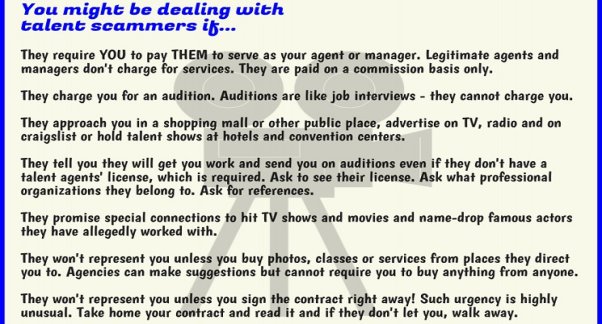
The L.A. City Attorney’s Office shares the Following Advisories to Actors & Parents of Young Actors:

Courtesy L.A. City Attorney's Office
Courtesy L.A. City Attorney’s Office

Casting Directors, Talent Agents, Directors & Actors

Love the Best-Selling Book for Actors
ACTING: Make It Your Business!

AMIYB_Amazon“Humorous and witty…
Actors everywhere who are trying to succeed in the business, young or old, on stage or on camera, anywhere in the world, take note:

This is your roadmap!”
BERNARD TELSEY, casting director – CSA
(NBC’s Peter Pan – LIVE!, Into The Woods – The Movie, Wicked, Sex & The City)
“All the right questions asked and answered…
and with a generous portion of good humor.”
SUZANNE RYAN, casting director, CSA
(Law & OrderUnforgettable)
“I love this book!
Paul’s book tells you what you don’t want to hear but really need to know
EVERY actor should read this book!”
DIANE RILEY, Senior Legit Talent Agent
Harden-Curtis & Associates
“Paul’s book made me proud to be a part of this community we call ‘show!'”
KAREN ZIEMBA, TONY & Drama Desk Award Winning Actress
“Paul Russell’s words are not only blunt & accurate they zero in on all the questions every actor wants to know but is afraid to ask!”
KEN MELAMED, Talent Agency Partner
Bret Adams, Ltd.
“I had my Business of Acting, BFA Seniors, class do book reports on a variety of “business of acting” books and ACTING: Make It Your Business came out a clear winner—considered to be essential for their bookshelves!
Dr. NINA LeNOIR,
Dept. Chair – Dept. of Thtr.
Chapman University

Get smarter on the business of acting from legendary Hollywood & Broadway actors and talent agents in a casting director Paul Russell’s Best-Selling Book ACTING:AMIYB_Amazon Make It Your Business!

Share this:

Share Answers for Actors:

Facebook Twitter More...

StumbleUpon.com
E-mail Post to Friends…

Follow Paul Russell Casting:

follow Paul on Facebookfollow Paul on Twitter

Paul Russell’s career as a casting director, director, acting teacher and former actor has spanned nearly thirty years. He has worked on projects for major film studios, television networks, and Broadway. Paul has taught the business of acting and audition technique at NYU and has spoken at universities including Yale, Elon and Wright State University. He is the author of ACTING: Make It Your Business – How to Avoid Mistakes and Achieve Success as a Working Actor. For more information, please visit www.PaulRussell.net.

Get One-On-One:

Get Work:

Follow:

Classes with Paul Russell Paul's book ACTING: Make It Your Business!

Paul on Twitter

Paul Russell on Facebook

Visit Paul @ PaulRussell.net


ACTING: Make It Your Business