Why Actors Can’t Act a Role | Answers for Actors

“How many dead brain cells does this moron possess?”

Yes, the last statement is immature but that is the inner monologue. And one that’ll kill an actor’s career. Because why would a director or casting director think of an actor for future casting when the prevailing perception of an actor is, “This actor hasn’t any self-awareness.”

Paul Russell
Visit Paul @ PaulRussell.net

Answer: The actor is not appropriate to the role.

Simple, right?

Not so for far too many actors who believe that they can cross racial and gender borders because somewhere, some (or far too many an) ass ignorantly instruct actors, “Submit and audition for anything and everything even if you’re not right for the role.”

Bullshit theocracy.

But sadly, there remain instances where wrong is foolishly practiced as right and invariably consequences occur.

La Jolla Playhouse and more recently the film Cloud Atlas were lambasted for casting non-Asian actors in Asian roles. I wonder how many non-Asian actors who believe they can play any role were a part of the disparaging chorus against the Caucasian casting discord? Were they within the Caucasian collective that recently self-submitted to me for roles listed as ‘Young Asian Actress’ and ‘Mature Asian Actress’?

Of the 235 self-submissions my office received for the two Asian roles, how many were from non-Asian actresses? 141! More than half! Did the erroneous self-submitted non-Asians believe that if cast, heavy eye-liner drawn back at their eye creases would make them ‘Asian Orientated’?

This is not a question of political correctness in casting but of casting appropriately to the ethnic parameters of a role. And more importantly; how YOU as an actor are perceived as either smartly knowing who you can portray, or if you’re viewed as a moron completely ignorant of logical limitations for appropriately portraying race, gender and/or color which match your genetics. (Please, don’t delve into a foolhardy argument citing cross-dressing, gender bending of LA CAGE AUX FOLLES or KINKY BOOTS, or the male chauvinist men of the antiquated days of when women were barred from the stage and men played female roles. Click your heels three times and repeat out-loud, “There’s no place like reality.”)

Asian roles are not the only characters assaulted for appointments by inappropriate portrayal believing actors. I’ve had whites self-submit themselves for black roles and blacks self-submit for white roles. Yes, there can be color blind casting. But when a role is a black slave of 1801 America or an Alabama Klan member of 1964, color blind casting flies in the face of logic and history. At my level of casting we are not in the fantasy world of community or academic theater casting or 1950s THE KING AND I eye liner and pancake casting.

My office was so frustrated by the bounty of Scandinavian-looking blondes pushing themselves for an Asian role that we contacted those actresses with the following email:

“The role you submitted for is Asian.

If you are of Asian heritage which is noticeably discernible you will be of course considered for the project.

Below is the breakdown as it appears in our outreach:

[YOUNG ASIAN ACTRESS] Early 20s. Plays Mya in HALF A WORLD AWAY. 17 years old. Burmese.”

The silence of shame in return by actresses was deafening… almost. There were several replies from non-Asian actresses similar to the following, actual replies:

“I am not of Asian heritage. If it is possible I would still like to audition, though I leave it to your discretion as to whether or not I could ‘believably pass’ as Burmese.”

One Caucasian woman (of a mature-certain-age, re: wrinkle city) wrote:

“I’m a great character actress able to play many roles and ages.”

(Yes, luv… and I’d make for a fabulous Beyonce.)

Now if you’re of the thinking, “But Paul, white actors were cast as Asians in highly visible projects, so it must be right” I answer; everyone involved in such casting was wrong to make implausible casting choices. (Yes, I’m arrogant enough to stand on my principle that entertainment cast color correct when a script, history or sensibilities dictate ethnic accuracy.)

To the actors who follow the misguided credo, “Submit and audition for anything and everything even if you’re not right for the role” know that the following is thought of you by the receiving casting personnel:

“Why is the actor wasting their time?”

“Why is the actor wasting my time?”

“How many dead brain cells does this moron possess?”

Paul's book ACTING: Make It Your Business!Yes, the last statement is immature but that is the inner monologue. And one that’ll kill an actor’s career. Because why would a director or casting director think of an actor for future casting when the prevailing perception of an actor is, “This actor hasn’t any self-awareness.”?

If actors do not know themselves, how then can an actor be expected to know and portray any entity?

Next!

My Best,
Paul

Share Answers for Actors:

Facebook Twitter More...

StumbleUpon.com
E-mail Post to Friends…

Follow Paul Russell Casting:

follow Paul on Facebookfollow Paul on Twitter

Paul Russell’s career as a casting director, director, acting teacher and former actor has spanned nearly thirty years. He has worked on projects for major film studios, television networks, and Broadway. Paul has taught the business of acting and audition technique at NYU and has spoken at universities including Yale, Temple and the University of the Arts. He is the author of ACTING: Make It Your Business – How to Avoid Mistakes and Achieve Success as a Working Actor. For more information, please visit www.PaulRussell.net.

Get One-On-One:

Get New Insights:

Get The Feed:

Classes with Paul Russell Paul's book ACTING: Make It Your Business!

Answers For Actors Feed

Visit Paul @ PaulRussell.net and/or:

Paul Russell on Facebook Paul on Twitter Paul on MySpace

Besos,

Paul

#1 Acting Essential for Successful Actors | Answers for Actors

98% of thespians I encounter quantifying themselves as artists are viewpoint blind actors.

Are you, as an actor, effectively communicating a viewpoint with each word you utter? Do you fully value viewpoints? It’s the rare actor that can make a single word layered with multiple variations of expression. In short; possess viewpoints simple or complex.

There are easy exercises to assist actors to be more effective on viewpoints.

Paul Russell
Visit Paul @ PaulRussell.net

98% of thespians I encounter quantifying themselves as artists are viewpoint blind actors.

Are you, as an actor, effectively communicating a viewpoint with each word you utter? Do you fully value viewpoints? It’s the rare actor that can make a single word layered with multiple variations of expression.  In short; possess viewpoints simple or complex.

There are easy exercises to assist actors to be more effective on viewpoints. But first, what is a viewpoint?

In auditions and projects which I direct I occasionally encounter actors who dart over phrases and words in which the actors of emotional ennui divest themselves of a connection, believing that words alone will do the labor required for facilitating story or character clarity. These lackadaisical linguists are actors failing to convey a viewpoint.

A viewpoint is similar to subtext but broader in definition beyond being ‘what’s not being said.’ A viewpoint, subtle or blatant, engages the listener to hear more than the word and digest the speaker’s (i.e. actor as a character) opinion, reaction, observation, desires, needs, objectives (or all of the preceding) when implemented to phrases or a single word.

Exercise #1: What’s Behind the Words?

Listen to your inner voice as you read the following excerpt from Lerner & Loew’s MY FAIR LADY. Eliza Doolittle confronts an ineffectual and undemonstrative suitor.

“Words, words, words
I’m so sick of words.
I get words all day through,
First from him
Now from you
Is that all you blighters can do?”

Now ask yourself the following:

  • Did you just repeat the opening of ‘words, words, words’ or did you isolate each with an emotional variant?
  • Did you consider the character’s emotional reaction towards ‘words?’  What is her viewpoint?
  • Is the first utterance of the word ‘words’ an explosion of angst representing her resentment towards people who value words more than action?
  • Could there be an underlying hint of her annoyance of her unspoken and yet to be consciously aware attraction for a man (not present) she believes both arrogant yet attractive? An attraction stronger felt than that for the suitor to whom she’s speaking?
  • Are the second and third utterances of ‘words’ merely echoes of prior emotion or… can the second ‘words’ be a question, as in ‘Why are vowels and consonants which cannot be held in hand more important to some people as opposed to embracing those we love? Is the final ‘words’ self-reflective; in which the character’s strength shows a crack of weakness?
  • When the character voices, ‘I get words all day through. First from him, now from you.’ how does her viewpoint differ between ‘him’ (referring to Henry Higgins) and ‘you’ (referring to Freddy Eynsford Hill)? In a flash the audience must hear the variances, whether one viewpoint is subtle confusion on ‘him’ as opposed to in-your-face contempt for ‘you.’
  • What does the character desire via these words? What’s the hoped for endgame? Is a resolve expected?

Many questions.

Similar inquiries as to your character’s viewpoint must be asked of and by yourself for nearly every word voiced as an actor for each character you portray, whether in an audition or production. (The actors who provide strong viewpoints in auditions are the actors who get paychecks in return.)

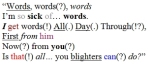
Now re-read the passage utilizing viewpoints I provided (in parenthesis and via text formatting). Listen to the difference within your inner voice as it reacts to the changes including how the color changes color your viewpoint.

Viewpoint

(Yes, it was a bit extreme… but hopefully you got the viewpoint(s) .)

Viewpoint Exercise #2: Observing Viewpoints

I recently directed the regional premiere of A FREE MAN OF COLOR in which I was honored to work with legendary John Guare (SIX DEGREES OF SEPARATION, HOUSE OF BLUE LEAVES). Below is text from AFMOC spoken by the character Meriwether Lewis as he encounters a hooded stranger in the wilderness of the uncharted Louisiana Purchase.

Read first and then we’ll discuss your interpretation on the other side:

“Hello? What tribe you from? I speak bit of Mandan. I’m separated from my party. You like pocket mirror? See self. Beads? Silk ribbons. Ivory comb. Tobacco. Tomahawk that can be pipe. Vermillion face paint.

(taking out list)

How long do Indians live?

How do you treat small pox?

Diseases of venery.

What kind of animals do you keep?

What kind of games do you play?

Does the Missouri flow northwest? Southwest?

Or just west?

I have food? Tasty beef and eggs and vegetable boiled into a paste? M-m-m! You want?”

Did you laugh your ass off when reading the passage? No? Well, if you, as an actor, were an effective thespian you would have discovered that the above text is a gold mine for laughs.

When I was rehearsing this passage with the actor playing Meriwether he rambled through the lines. I stopped him and asked, “What’s your viewpoint?”

To his silent questioning face I elaborated, “Here is Meriwether Lewis meeting an unknown entity. Does the person he is meeting understand English? Does the stranger hear him? Even if the stranger had a slight comprehension of the encounter how much of the questioning is understood?”

I asked the actor to demonstrate each of his inquiries. Give vocal and physical viewpoints of Meriwether to each question: Let the stranger and audience know Meriwether’s relationship / knowledge to the objects or actions within his questions.

When the actor spoke about diseases of venerary he vocalized (and displayed) Meriwther’s perhaps own history and experience with syphilis or gonorrhea. The actor brought opinions and reactions to nearly every inquiry within the passage.  (The tomahawk became great fun when I asked the actor, “So what weed do you think Indians smoked?”) The actor delved beyond what was written on the page and brought his and his character’s viewpoint to the words. He was no longer just reciting but living. He was being a successful story-teller. He was working the number one essential required to be an actor.

Exercise #3: Viewpoints are Reactions:

Finding a viewpoint is simple. How do you react to the following words:

Fart

Anchovies

Chocolate

Roses

Now bring your viewpoints for each of those words when combined in the following sentence:

“His farts smell of anchovies and chocolate; never of roses.”

You may like ‘his’ farts because you’re allergic to roses. Or you may be conflicted between disgust and contempt because you hate anchovies but love chocolate and now chocolate is ruined for you by his gaseous emissions.

On a recent master class visit to Elon University I encouraged students to provide various viewpoints to the individual words and then I scrambled the positioning of the words (and students creating opposite viewpoints to their original ones) within the sentence. This jumbling of strong viewpoints made for interesting interpretations of the same words when utilized differently.

Whatever your opinion, reaction, observation… bring viewpoints to whenever you speak as an actor.

My Best,
Paul

AMIYB_AmazonRead advice from legendary talent agents,
plus Hollywood & Broadway actors in Paul Russell’s Best-Selling Book ACTING: Make It Your Business!

Share Answers for Actors:

Facebook Twitter More...

StumbleUpon.com
E-mail Post to Friends…

Follow Paul Russell Casting:

follow Paul on Facebookfollow Paul on Twitter

Paul Russell’s career as a casting director, director, acting teacher and former actor has spanned nearly thirty years. He has worked on projects for major film studios, television networks, and Broadway. Paul has taught the business of acting and audition technique at NYU and has spoken at universities including Yale, Temple and the University of the Arts. He is the author of ACTING: Make It Your Business – How to Avoid Mistakes and Achieve Success as a Working Actor. For more information, please visit www.PaulRussell.net.

Get One-On-One:

Get New Insights:

Get The Feed:

Classes with Paul Russell Paul's book ACTING: Make It Your Business!

Answers For Actors Feed

Visit Paul @ PaulRussell.net and/or:

Paul Russell on Facebook Paul on Twitter Paul on MySpace