What’s NOT Being Said

Paul Russell
Photo Credit: JackMenashe.com

Rational people, unlike Glenn Beck or Rush Limbaugh, refrain from verbally vomiting every thought. In our daily lives behind masked metaphors and parsed phrases we sometimes insinuate unspoken declarations, inquiries, motivations and/or desires. Adept writers seize upon this indirect communication characteristic and place unwritten sub-text behind what is being said. The actor that plays more than the words literally written on the page is the actor that succeeds.

When presented an audition side or a script for a project don’t be lulled into a false sense of security that what is written is only what is being said. It’s your job as an actor to dive into the currents that lie underneath the surface of the words that float upon a page. Ignore that advisory and you’ll drown in a career reminiscent of Gary Coleman.

So how to delve? You ask questions. How? Let’s take a look at material from an audition side of a recent screen project.

The set-up: A couple, now split; have run into each other for the first time since they ended the relationship.

DIANE

You were really good.

ANDY

Thanks…,

DIANE

Who’s decision was it to do that song?

ANDY

Mine. I’m solo now.

DIANE

I know. The group told me.

ANDY

I decided to do something different.

DIANE

I know… Miss me?

ANDY

Uh…, yea, sure…

DIANE

You wanna come over?

ANDY

No.

DIANE

Why not? What’s the matter?

ANDY

You put me out in the street.

DIANE

Andy, I only asked you to leave because you wouldn’t get a job. I couldn’t support you.

——–

Now ask yourself, What’s going on here in this scene? When the echo chamber in the cranium rings with response(s) move to the next paragraph below.

Back? Good. You move fast. O.K. now; let’s see what you’ve gleaned from this slice of a scene. Which of the following just took place? (Vote; then read the rest of the post.)

If you answered: əʌoqɐ əɥʇ ɟo llɐ ˙ə then you’re on the money for what is not being said. (For those of you who can’t read upside down the answer was: ‘E. All of the above’.  I didn’t want your ex cheating… again.)

Writers are not going to write the obvious which if we put the motivations into words the scene would have read as a sophomoric, simplistic snooze-inducing fest:

DIANE

You were really good. Sorry I tossed you out onto the street. But, hey you were a loser. Capital ‘L’. You’ve gotten a lot better and probably could make a living at this now.

ANDY

Thanks.

DIANE

Did you miss me? Because I’ve been missing you and my sex life just hasn’t been the same without you. Wanna fuck?

—–

O.K. So if we wanted to save time this would have been the way to go. But how boring for you and me as audience members to have every statement spelled out for us. (Will Ferrell flick anyone?)

When I teach and direct I am always asking the actor; “What’s not being said?” My asking is not a test. I ask so that the actor begins to think. Now if they come back at me with a direct line quote, well then yes, they’ve failed the test. (O.K. I lied about the test thingy.)

Let’s go back and delve into the original text and see what the writer was not saying directly in dialogue (sub-text in italics):

DIANE

You were really good.

(You’ve proved yourself. You’re not the guy that I used to know who spoke of dreams but couldn’t get anywhere.)

ANDY

Thanks…,

(A compliment? There’s something new for you. I appreciate that. What took you so long to notice and what is that you want?)

DIANE

Who’s decision was it to do that song?

(I really enjoyed what you did. You’re work is growing and yes, I’m intrigued now more than before. You’re independent. A little stand-offish. O.K. I get that because I threw you out.)

ANDY

Mine. I’m solo now.

(I’m no longer co-dependent. And I really don’t feel like talking much more so let’s just keep this short and polite, o.k.?)

DIANE

I know. The group told me.

(I’m sorry. I knew about the song choice. I just wasn’t sure if the others were covering for you by telling me you chose that song because I was here or if you really have made some positive changes in your life.)

—-

It’s your job to find and play the sub-text. If it were written out (as above) the audience would be bored more so than if watching dead grass grow.

This delving into the words (as I discuss extensively in ACTING: Make It Your Business) also applies to song lyrics. Unless of course it’s Tim Rice drivel like:

“Only goes to sho-wa,

Greatest man since No-ah”.

(Oh, Tim.)

So when approaching a scene, song, or monologue ask yourself, What is the writer not saying in the dialogue? What is being said between the lines? What’s the sub-text? What’s the objective? What are the layers I’m to add in playing this? What does this character need and/or want from this situation? It’s then you’ll discover what intent is being said behind the lines of what is actually being spoken. It’s then that you’re viewed as a more successful and intelligent actor. (And not a catch-phrase wonder… “What you talking ‘bout Willis?”)

Add your own sub-text to that last parenthetical.

===

The LAST musical theater Access to Agents for this season will be in April. The seats for the past three seminars have gone in less than a week of initial announcement. For details on this last chance (before the fall)  to present your musical best to a panel of agents visit: http://paulrussell.net/Access_to_Agents.html.

Besos,
Paul

Bookmark and Share

<a href="http://www.stumbleupon.com/submit?url=&title=”&gt;StumbleUpon.com
E-mail This Post to a Friend or Two…

Paul Russell’s career as a casting director, director, acting teacher and former actor has spanned nearly thirty years. He has worked on projects for major film studios, television networks, and Broadway. Paul has taught the business of acting and audition technique at NYU and has spoken at universities including Yale, Temple and the University of the Arts. He writes a column for Back Stage and is the author of ACTING: Make It Your Business – How to Avoid Mistakes and Achieve Success as a Working Actor. For more information, please visit www.PaulRussell.net.


Get One-On-One:

Get Work:

Get The Feed:

Classes with Paul Russell Paul's book ACTING: Make It Your Business!

Answers For Actors Feed

Visit Paul @ PaulRussell.net and/or:

Paul Russell on Facebook Paul on Twitter Paul on MySpace

What is THAT Smell?!

This week: The Stench of Desperation; Actors Trying too Hard

You and I both know how difficult the challenge often is to garner attention in our business. I’m speaking of positive, career-forward recognition, not the Lindsay Lohan lapses of judgment.

I’ve written in my book and spoken in classes of past gimmicks of actor ‘Look-At-Me!’ foibles that I and my colleagues have come upon. Ranging from footwear bribery, attempts at culinary collusion for a callback to cereal boxes loaded with an actor’s reel hidden deep within the cornflakes. (It’s not the children of the corn that are always the flakes.)

So, yes, I and many casting directors, talent agents, artistic directors, directors, choreographers, managers, producers, anyone who gives the nod of affirmation for employ has seen their share of actors trying too hard to gain attention. And there’s a single word for this act; desperation.

That noun describing an action or state of despair once displayed is difficult to remove from the memory of those who witness it. Kind of like the stench from when having a run-in with a skunk. The odor of desperation follows you. And sadly, people who make attempts for attention don’t often see themselves as coming across as desperate. With noble intent they charge forward in a manner that turns off their objective. Think of one of your past loves who whined or were needy for you and how disenchanted you became of their arduous affections. They, with a heart full of great desires, were desperate. The cause? For each scenario that differs. Sometimes fear of failure lures one to desperation. But often insecurity is the main culprit that leads the innocent into committing an act of desperation.

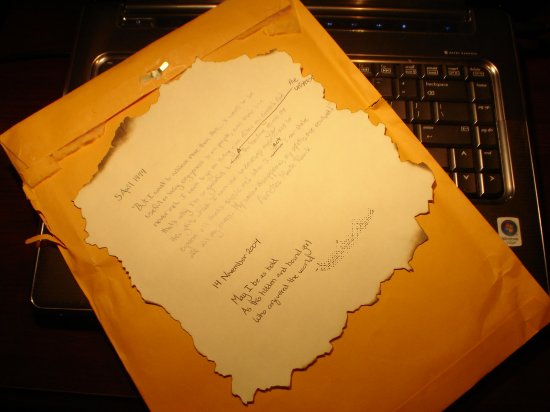
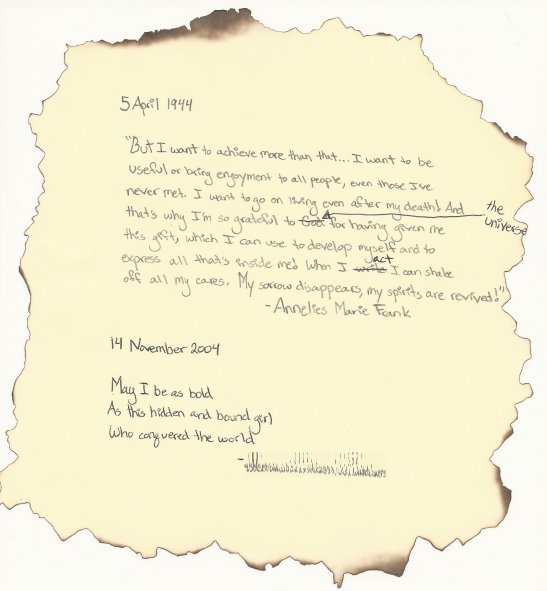
While casting for the national tour of The Diary of Anne Frank my office received possibly one of the more misguided attempts to gain attention and an audition appointment. Below are images of her cover letter. The actress’ name I’ve altered for privacy. Sadly the burn marks made by the sender for make-believe-authenticity are authentic to the actress.

Now take a closer look below and you’ll see that the actress, in attempt at making her cover letter look as if it were ripped from Anne’s diary, was summoning the departed victim of one of mankind’s darkest hours.

The actress’ intent went beyond desperate to bordering on an obsessive passion for the real-life character.

Entertainment is a business. When pursuing the employ of fantasy the pursuit should be as professional as with your approach to finding your survival jobs. I doubt that you would (and hope that you would not) send a query letter for employment like the above to a Fortune 500 company, the Trump Organization or any civilian employer.

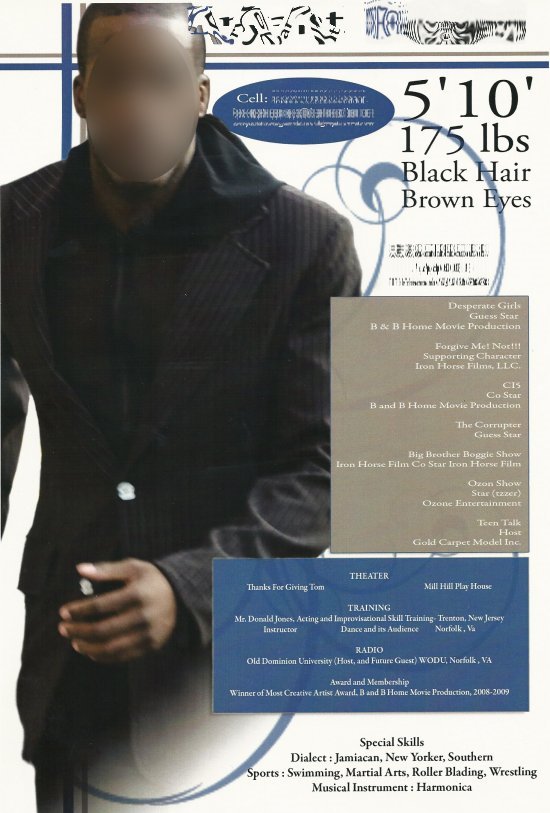
My partner, the talent agency owner, recently received an 8”x10” mailing (below) from an actor that could be interpreted by any recipient to be another act of desperation for attention. Now, the young man probably did not perceive such as he spent many hours and monies upon marketing that he believed to be professional and slick:

Yes, it is a bit polished. No, you should not do similar. As a comp card? Possibly. As a headshot and resume which the above was intended to be? It’s too slick for our purposes. It and the actor try too hard. Less is more. A simple headshot with on the back a résumé printed on clean, crisp, white paper. That package would have been more effective and apropos.

But it wasn’t just the irregular P&R format that caught my attention. There was also a lengthy, five-paragraph, cover letter full of prose  containing near nothing as to valuable, substantial information like; education, past projects, and people he has worked and/or studied with. Much of the content mirrored the following phrase:

“Throwing my headshot into the trash can would be a mistake… some agent is going to make a lot of money.”

Oh, no he didn’t. But oh yes he did.

Now you may be formulating the following thought, But Paul, he got your attention. Yes. Yes, he did. But it’s not the kind of attention I believe he wanted. My initial reaction was, “My God, how much time and money did this young man spend to put together a mailing that overcompensates for lack of substance in his work history?” He was trying too hard to make up for a thin resume. Of which the latter (a thin resume) is not a crime or fault.

I and my colleagues would be thrilled to see the exampled actors here (and similar like them) succeed by making professional-in-appearance choices in their journeys instead of driving down dead-end driveways of desperation. I give hardball tough love here, in my book and in classes because I honestly want success for every actor I encounter. Their success is my happiness. Not because I arrogantly believe myself to be right but because I don’t enjoy seeing actors fail as a result of simple mistakes they have made. Overcompensating is one of those easily tripped upon errors.

We all begin with nothing. Be proud of what you have to offer. Don’t subjugate substance for splash. Don’t go Six Flags fireworks on your resume to overcompensate for a mom-n-pop history. Some of the most productive producers of story-telling art have been those lesser known venues. Never be ashamed. (And unless you want to permanently destroy a cover letter never take a match to your missives.)

You know where we all should be trying too hard? At enjoying life. Living to our fullest potential has no odor of desperation.

Besos,
Paul

Bookmark and Share

<a href="http://www.stumbleupon.com/submit?url=&title=”&gt;StumbleUpon.com
E-mail This Post to a Friend or Two…

Paul Russell’s career as a casting director, director, acting teacher and former actor has spanned nearly thirty years. He has worked on projects for major film studios, television networks, and Broadway. Paul has taught the business of acting and audition technique at NYU and has spoken at universities including Yale, Temple and the University of the Arts. He writes a column for Back Stage and is the author of ACTING: Make It Your Business – How to Avoid Mistakes and Achieve Success as a Working Actor. For more information, please visit www.PaulRussell.net.


Get One-On-One:

Get Work:

Get The Feed:

Classes with Paul Russell Paul's book ACTING: Make It Your Business!

Answers For Actors Feed

Visit Paul @ PaulRussell.net and/or:

Paul Russell on Facebook Paul on Twitter Paul on MySpace