

Overheard in a cramped and cobwebbed audition corridor:
“The casting director is a dick.”
“The pianist sucks.”
“My English lit teacher was a better reader.”
“I think the director’s doing bath salts.”
“They hate actors.”
“You really don’t want to go in there.”
Actors at auditions spewing audition studio scuttlebutt to other actors: The most insidious and uninformed observation one actor can share with their peers. Even if the actor bounded out of the audition studio on a Disney-esque high with, “They loved me! They asked me to read twice and share my recipe for vegan crab dip.”
(Next.)
Planted—long before The Globe’s foundation was dug—was the actor gossip vine. It still thrives and snarls its sinews around audition sites destroying fellow actors’ auditions with actors relaying their impression of auditor behavior. Often the poorly plucked fruit is seeded with false information, an assumptive impression or a prejudiced opinion. Unless the actor is amazingly telepathic their auditor reaction insights should be regarded with as much credibility as anonymous berating bears on RateMyProfessors.com.
You may recognize the more popular eye-rolling actor observations below. But have you given thought to potential reasons for the auditor’s reactions as relayed?
“They didn’t smile.”
The auditors are often intensely focused on analyzing an actor’s skill and appropriateness to the casting. They’re not a wedding party receiving line. Often (and sadly) at auditions you’ll be before more Gordon Ramsays than you’ll encounter Paula Abduls. Yes, it would be grand if all auditors glowed with heavily medicated grins but the creases incurred from constant smiling are deeper than is our cash stash for collagen and Botox repair. Don’t focus on us. Focus on you. You’ll live happier.
“They laughed, so they must have loved me.”
The auditors may have loved you. But they also may have loved that you presented an inspired, fresh perspective to the audition material. The laughter you garnered was genuine appreciation for the much needed levity during a hemorrhoid endurance test. As to whether or not you’re appropriate for the casting depends on many factors beyond several guffaws. Pocket the laughs and move on to the next audition.
“The director barely spoke.”
Possibly, the director is not a party animal like yourself. Maybe, the director was in deep contemplation of your sterling talents. Perhaps, he just received word from the veterinarian that the time has come to put down his Fluffernutter. Or simply, the onion rings from lunch left the director with dragon’s breath and he/she doesn’t want to scorch your sensitivity. Don’t focus on the director’s reaction. Focus on your actions.
“The reader was a corpse.” | “The pianist was cold.”
The pianist hasn’t been hired as a nightclub act. Good readers are a hard find.
Unlike my auditions (where I need to trust the reader more than I do the actors coming into the room) most readers work for free and are pulled from a pool of who’s available and breathing.
With pianists, the good ones are few and very expensive. (I strive to find the best…and it’s costly.)
But good or bad both the reader and the pianist are mentally and physically taxed during a grueling assembly line of actors for eight hours; sometimes longer. Auditors and their staff are not allotted much, if any, rest while seeing hundreds of actors in a single session. Working an audition is a mental and physical calisthenic challenge that runs continuously for hours.
Am I excusing poor auditor behavior? (Those who recall my scathing and very public response to Twittergate, know better.) The affable audition-room manner many of my clients present to actors should spread like a happy virus. Unfortunately, that congenial contagion hasn’t carried to some casting colleagues.
If the auditor’s manners are truly foul that’s their life’s problem, not your immediate worry. I’ve heard tragic tales from actors telling of allegedly rude auditors. But without my having been an eyewitness to the interaction I cannot comment nor place an opinion on the allegations. I’m receiving a stranger’s reaction to an event that didn’t go as they had hoped. And I leave the telling as their personal observation—not an edict etched in stone. As well should you when you encounter an actor bitching or praising the auditors they just met as you’re about to exchange an entrance for your peer’s exit.
You’re more than aware of your stress level at an audition. Possibly your foot taps the dust bunny laden floor. Maybe you crunch your knuckles. You worry, “Will they like me?” “I owe two months back rent.” You needn’t have your anxiety’s embers stoked by an actor flaming out in the audition hallway about the auditors. You weren’t in the room. You don’t know what really happened. Don’t listen to the fodder because if you do, the focus of your audition won’t be prioritized to what is most important: telling the author’s words in an effective manner that will have the auditors engaged in you as an actor who can solve their casting puzzle.
When I was an actor I rarely spoke or listened to my audition hallway neighbors. I didn’t want my work compromised by the insecurities of others—I have enough of my own doubts, thank you very much. I don’t lug other people’s baggage. And neither should you.
When at an audition, focus on you. Avoid the actor gossip grapevine and don’t harvest sour pickings yourself. Actors who share auditor behavior (good or poor) have a reason for doing so. Ask yourself, “Why?” Are their disparaging barbs (or gushing gloats) about the director to embolden your endeavor or to weaken your resolve to profiting a job opportunity? No one person passes an opinion without having an agenda.
The enemy is not the auditor. We want you to succeed (our job is then made easier). The enemy is often a competing peer seeding doubt in your garden of anxieties. Don’t let the weeds strangle your blooms.
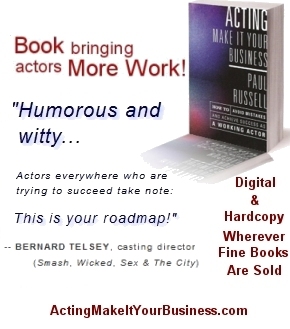
[Want to know how Broadway and Hollywood actors deal with auditors, discover for yourself in ACTING: Make It Your Business. And yeah… there’s lots of other goodies in the Random House read that casting director Bernie Telsey calls, “Humorous and witty. The actor’s roadmap!” www.ActingMakeItYourBusiness.com ]
My Best,
Paul


E-mail This Post to a Friend or Two…
Paul Russell’s career as a casting director, director, acting teacher and former actor has spanned nearly thirty years. He has worked on projects for major film studios, television networks, and Broadway. Paul has taught the business of acting and audition technique at NYU and has spoken at universities including Yale, Temple and the University of the Arts. He writes a column for Back Stage and is the author of ACTING: Make It Your Business – How to Avoid Mistakes and Achieve Success as a Working Actor. For more information, please visit www.PaulRussell.net.
Get One-On-One: |
Get New Insights: |
Get The Feed: |
 |
 |
|

Visit Paul @ PaulRussell.net and/or: |
||
 |
 |
 |



 Answers for Actors
You must be logged in to post a comment.