AI Actors Like Tilly Norwood Threaten to Decimate Hollywood — Here’s How We Resist and Reclaim Our Future

Particle6’s Tilly Norwood isn’t a breakthrough. She’s a warning. Replace actors, and you erase crews, designers, writers, sets — the entire ecosystem. #HollywoodResists

We Don’t Fall in Love With Artificial
— A Manifesto for the Human in the Age of Synthetic Storytelling

“Oh, I just love them!
Aren’t they both wonderful in everything they do?”

Two friends, chatting over coffee, might be talking about Julia Roberts, Meryl Streep, Tom Hanks — actors whose names carry warmth, history, and trust. We know them not just for their performances, but for their humanity: their stumbles, their resilience, their laughter, the way time etches itself into their work.

We love Julia Roberts not just because of her laugh on screen, but because it feels like hers — idiosyncratic, slightly unpolished, impossible to replicate. We love Tom Hanks not because he plays “everyman” perfectly, but because his particular humanity makes us believe him.

Truth: we don’t fall in love with perfection. We fall in love with the authentic.


Now imagine the same conversation in a world where the “them” is not about a living, breathing person — but an AI-generated actor. A synthetic, digital human-like form designed by code in a lab, programmed for flawlessness, executing pathos at the click of a keyboard.

We can conjure an AI actor who laughs like Julia, commands authority like Streep, or exudes empathy like Hanks. To our eyes and ears, the differences between authentic and artificial blur. But beneath the surface, there is a hollowness.

The “performance” has no lived experience: no childhood memory, no heartbreak, no human carrying decades of history.

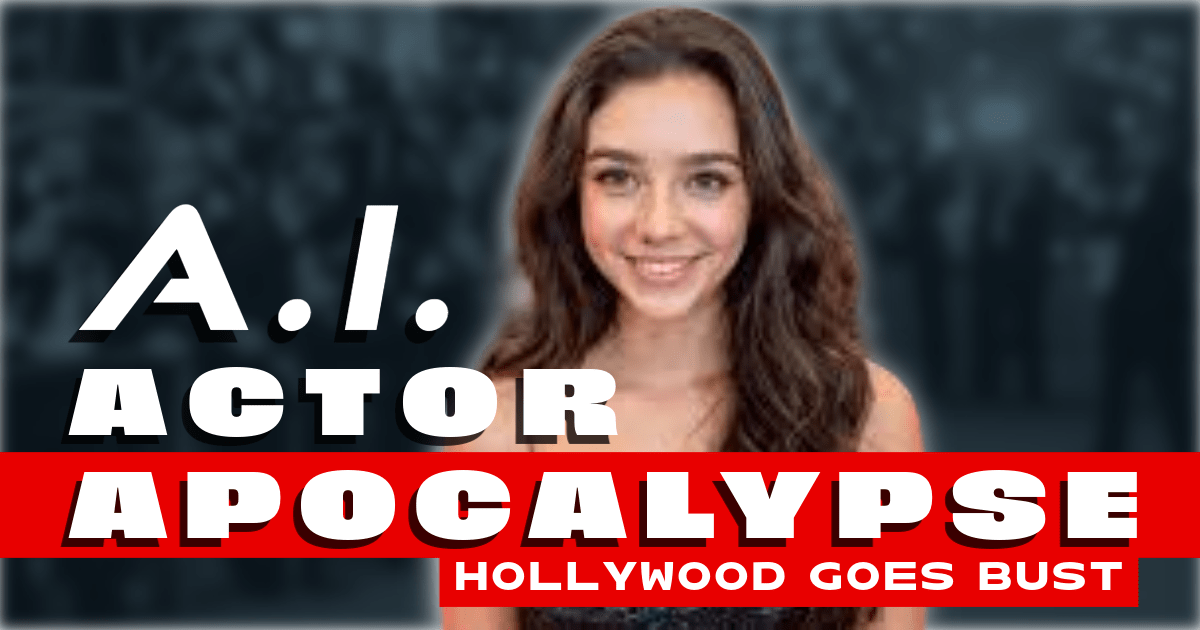
Instead, “them” (it) is Tilly Norwood, an AI-generated “actress,” created by Particle6 Studios and its virtual-talent factory, Xicoia.

Particle6 and Xicoia have already seeded Tilly across TikTok, Instagram, and YouTube — a carefully engineered avatar designed to be “castable, directable, available on demand.” The next headline: she will be the first AI model signed by a Hollywood agency.

The sales pitch: She’ll never age, never demand pay parity, never need a break. Her directors will face no scheduling nightmares, no on-set disagreements.

This is not some “what if” scenario. This is happening. Studios are taking the bait. Agencies smell commission checks. Journalists frame it as innovation.

But peel back the hype and the cracks show:

  • The uncanny valley remains. She moves, but with the eerie dissonance of something that almost passes as real.
  • The “signing” is a publicity stunt, normalizing the idea that an algorithm deserves a place on the same rosters as living artists.
  • Once entrenched, this “experiment” becomes precedent — quietly, irreversibly.

What We Stand to Lose

Remove the living actor and the collapse doesn’t stop there. The loss ripples:

  • Actors: the heartbeat of story, replaced by motion-capture shells and synthetic faces.
  • Designers, makeup, and wardrobe: no longer needed if costumes are rendered in code.
  • Crew and craftspeople: grips, lighting teams, carpenters, scenic artists, craft services — entire professions vanish.
  • Casting directors and agents: bypassed by machine-generated “talent.”
  • Directors and writers: reduced to prompters and data wranglers.

“The entire ecosystem — from truck drivers to wig makers — is tied to the human presence of performers. Strip that out, and the scaffolding collapses.”

This isn’t just about actors. It’s about an industry gutted at its core.


When AI Mimics the Soul

I’ve lived this terror personally.

I wrote Wicked Journeys — a story seeded in my life: a 19-year-old actor with HIV drifting between theater, love, loss. It carried me from 2002 to 2016 when a publisher expressed interest in bringing my first novel to the public.

Recently, I fed its premise into AI: “Write the story.” What came back was a hollow ghost. The form was there. My voice and heart? Gone.

“The AI imitated the journey but the humor, soul, and relationships of the characters didn’t have the energy and drive to carry the story.”

AI technology can mimic creativity but fails to imagine organically. Without the wonder of imagination, there is no heart, no life.


The Questions That Haunt

  • If every performance can be synthesized, what remains for human artists?
  • Will we be reduced to administrators of our own erasure?
  • How do we feed ourselves when our livelihoods are replaced by algorithms?
  • What kind of world do we leave behind when all art is fabricated illusion?

“These questions are not philosophy. They are survival.”


Resistance: What Must Be Done

If this feels like a fight for existence, that’s because it is. Resistance means refusing to normalize machine actors as legitimate peers.

  • Name the threat: Call out AI “talent” as simulations, not artists. Never allow their framing to equalize human and machine.
  • Union fortification: SAG-AFTRA, IATSE, DGA, WGA — every contract must explicitly ban synthetic “talent” from replacing human labor.
  • Policy and law: Demand legislation requiring clear labeling of AI-generated media. Push for compensation when AI uses our likeness, voice, or work as training data.
  • Audience awareness: Teach the public to question what they see. To understand that art without humanity is product, not story.
  • Collective refusal: Creatives must stand united in declining to feed these systems our work. The more we train them, the more we accelerate our own disappearance.

Resilience: How We Reclaim the Future

Resistance alone is not enough. We need resilience — a blueprint for what survives:

  • Reinvest in the live: Theater, concerts, site-specific performance — the experiences no AI can replicate. Presence becomes protest.
  • Build human-first studios: Independent companies committed to hiring flesh-and-blood actors, crew, designers. Create an ecosystem outside corporate adoption.
  • Educate audiences: Lead campaigns that showcase the raw, messy, irreplaceable beauty of human work.
  • Hybrid on our terms: Use AI as a tool, not a replacement — a lighting match, not the fire. Harness it for scheduling, budgeting, research — but keep the soul human.
  • International solidarity: Connect with creators globally. What starts in Hollywood echoes everywhere. This is a fight for art, not geography.

“Resilience means not just surviving — but reclaiming the ground, redefining the value of humanity in art.”


The Call

This is not about nostalgia. This is about survival.

If we allow corporations to normalize avatars like Tilly Norwood as the “future of acting,” then acting itself dies. Along with it: the crews, the designers, the artists, the voices.

Art becomes just another supply chain. We become just another audience for hallucinations.

“We must resist. We must build resilience. We must say — loudly, without hesitation: We don’t fall in love with replicas. We fall in love with the real.”

Because once the human is gone from art, the world doesn’t just lose entertainment. It loses its soul.

About Paul

Paul Russell’s career in the entertainment industry spans over forty years as an award-winning casting director and stage director. He has cast for 20th Century Fox, HBO, Broadway, and major regional theaters.

A frequent guest artist at university BFA and MFA actor training programs, Paul also teaches private master classes to actors worldwide.

He is the author of the expanded Second Edition of ACTING: Make It Your Business – How to Avoid Mistakes and Achieve Success as a Working Actor.
Top 10 Email Mistakes Actors Make

Email marketing by actors is fraught with career-hobbling traps. The following email blunders are the most often used career-stopping snares by which actors maim opportunities.

Email Mistakes_a4a

actor email

Paul Russell_HeadshotPaul Russell
PaulRussell.net

Email marketing by actors is fraught with career-hobbling traps. Convenience and speed lull actors in to a false sense of accomplishment in their marketing outreach to entertainment professionals who hire or represent actors. The following email blunders are the most often used career-stopping snares by which actors maim opportunities.

1. Forwards

Actors forwarding their prior sent email(s) to industry by sending as ‘new’ old correspondence to other industry contacts advertises that the actor is lazy.

email


Recipients see in an email’s subject the abbreviation ‘FWD.’ When a FWD recipient sees the abbreviation a red flag is signaled that the sending actor is complacent, and sloppy with their marketing which further translates into an image that the actor is likely just as much an unprepared sloth regarding their acting skills.

Actors who wish that consideration of their career be taken seriously as a professional must approach each professional as an individual—not as a check-mark accomplished in the actor’s marketing whoredom.


2. Email Addresses that are Tinder or Grndr Bound

How serious of casting or representation consideration of an actor is an entertainment gatekeeper to pursue when an inquiring actor has an email address beginning with ‘SexyStarr@,’ ‘MyOscarAwaits@,’ or similar correspondence handles? About as seriously as an actor shouldn’t consider a director, agent, or casting director if any of those acting job enablers has an email address that is MakeYouFamous@hotmail.com.

An actor’s email address is a reflection of their professionalism. An actor’s work email address is to begin with a derivation of the actor’s name, followed by the email carrier that the actor utilizes.


3. Dear Mr./Mrs. as Greetings

I’ll never be a Mrs. or a Mr. (my testicles don’t respond to either greeting).

As unprofessional and crass is my prior commentary so too are generic openers. If an actor wishes to be treated as an individual, then the actor must give the same desired respect to all entertainment professionals encountered.

We are given names—identities. We are not pronouns but nouns. An actor sending an email blast to 10 or 10,000 individuals may either copy-n-paste the body of the email into each individual message, and then manually type in the recipient’s name. Or, the actor could save time and hours of tedium by learning what is a database and how a ‘field’ inserts an individual’s name or other content into a mass email blast.

Yours Sincerely,
Mr./Mrs./Ms./It


4. Begin with Positive not Negative

From a recent actor’s email:


“As a casting director you may literally go through thousand [SIC] of cover letters and resume [SIC] every day,”


First impression upon reading the actor’s opener is, “This isn’t going to go well for the actor.” And I’m correct. The remainder of the opening sentence in the email continues:

“…and most of the time you wind most of these letters in the trash can.”


The email is on a laptop screen, not on paper in my hand.

Plus, there seems to be a verb or two missing in the statement. Or maybe the writer envisions that like a clock’s cogs I wind trashed paper counterclockwise in my trashcan. Or possibly I pass wind on letters in my trashcan.

What an actor writes—and how—presents a perceived value by the reader on the actor’s acting skills. The actor mistakenly continues…

“I would like to tell you unlike most of the stars, I have taken this career seriously. I have converted this profession into my work ethic.”

Next.


5. Incorrect Capitalization

From an actor’s email to casting:

“Being a Film Actor who has been an Actor for many years I know your office to be the best Casting Office with many Casting Directors who work on Stage and Screen Projects. My Acting Training is extensive at many Performing Arts Schools…”

If you cannot detect the 15 capitalization errors in the prior sentences, get thee to an unpretentious ghostwriter to write your correspondence.


6. Attaching (multiple) Headshots, Resume(s), or Reel(s)

An actor’s resume is to be placed within the body of an email (See here).

Attachments slow the incoming email program of your target, which in turn doesn’t endear the actor to the entertainment professional.

Attachments also signal to email providers that an incoming email with a single or multiple attachments is potentially SPAM.

Attachments are also suspect. A large percentage of people using email will not open attachments from an unknown sender.

Include, along with your formatted resume in the email body, a thumbnail of one headshot. Also include a link to your website.


7. Using Vocabulary that Doesn’t Match Your Speaking Voice

8. Using lots of Vocabulary to Say Nothing of Substance

9. Not Having a Proof Reader

10. Telling the Reader You’re Serious About being an Actor

In the following excerpt of an actor’s email all blunders, 7-10, happen simultaneously:

“I would appreciate if you see my resume wherein I have mentioned my experience and knowledge. If your watched my reel you can see how seriously I have taken this profession.”

For a guide on how to write effective actor marketing emails, and cover letters get the best-selling acting book that the casting director for HAMILTON calls, “the actor’s roadmap!” Read ACTING: Make It Your Business.

And… take control of your career in the acting master class that I teach at dozens of universities across the U.S. A 4-week intensive covering actor marketing, audition technique improvement, finding your brand/voice, and how to take control of an audition, and gain more work. 3 industry executives join me in guiding your work. Details @ http://paulrussell.net/AMIYB_MasterClass.html

My best,
Paul

Share this:

Paul Russell’s career as a casting director, director, acting teacher and former actor has spanned thirty years. He has worked on projects for major film studios, television networks, and Broadway. Paul has taught the business of acting and audition technique at NYU and has spoken at universities including Yale, Temple and the University of the Arts. He is the author of ACTING: Make It Your Business – How to Avoid Mistakes and Achieve Success as a Working Actor. For more information, please visit www.PaulRussell.net.

Casting Directors, Talent Agents, Directors & Actors

Love Paul Russell’s Best-Selling Book for Actors
ACTING: Make It Your Business!

Actors everywhere who are trying to succeed in the business, young or old, on stage or on camera, anywhere in the world, take note:

This is your roadmap!”
BERNARD TELSEY, casting director, CSA
(Hamilton, The Intern, NBC’s The Wiz – LIVE!, Into The Woods – The Movie, Wicked)
All the right questions asked and answered…
and with a generous portion of good humor.”
SUZANNE RYAN, casting director, CSA
(Law & OrderUnforgettable)
“I love this book!
Paul’s book tells you what you don’t want to hear but really need to know
EVERY actor should read this book!”
DIANE RILEY, Senior Legit Talent Agent
Harden-Curtis & Associates
“Paul’s book made me proud to be a part of this community we call ‘show!'”
KAREN ZIEMBA, TONY & Drama Desk Award Winning Actress
“Paul Russell’s words are not only blunt & accurate they zero in on all the questions every actor wants to know but is afraid to ask!”
KEN MELAMED, Talent Agency Partner
Bret Adams, Ltd.
“I had my Business of Acting, BFA Seniors, class do book reports on a variety of “business of acting” books and ACTING: Make It Your Business came out a clear winner—considered to be essential for their bookshelves!
Dr. NINA LeNOIR,
Dept. Chair – Dept. of Thtr.
Chapman University

Get smarter on the business of acting from legendary Hollywood & Broadway actors and talent agents in a casting director Paul Russell’s Best-Selling Book ACTING:AMIYB_Amazon Make It Your Bu