
This week: Twittergate – A final thought & reflection
 I didn’t want to continue a discussion on last week’s “Twittering from The Audition Room” by a casting director. But the response to my last blog, A Casting Director’s Rude Behavior characterized by Back Stage as “chastising” was overwhelming with people e-mailing and calling me; stating that they would report Ms. Eisenberg’s audition room behavior to C.S.A. (Casting Society of America) and A.E.A. (Actors’ Equity Association).
After meeting with A.E.A. on Friday, August 14; Ms. Eisenberg offered, via Twitter an, apology:
“I apologize to the actors and professionals who put themselves on the line every time they audition… By mutual agreement, future tweets will not be coming from the audition room regarding the actors auditioning.“
Now is the time for everyone to move forward from this incident and begin the process of forgiveness for an error in judgment (which we all have made from time-to-time).
But before final closure an afterthought:
While reading the deluge that came in response to my response to the original inappropriate actions of said casting director tweeting live audition feedback of actors publicly (original blog here) a thought came to mind: Actors believe that casting directors are fully accountable to unions or an organization. We’re not. And therein lies part of the problem which prompted last week’s inappropriate behavior. Some casting directors believe themselves impervious to consequences for their actions. Which leads to a mindset of “I answer to no one but myself and that gives me power over you.” “You” being the actor, talent agent or manager.
Actors you are not the only ones who must endure, at times, rude behavior from less-than-despicable casting personnel. Agents and managers must often face that same abuse when trying to push their clients to a casting director. If you think your last audition was met with frost from the Antarctic presence behind the audition room table imagine what a talent rep. faces from that same iceberg on the phone or in the cold life-less text of an e-mail.
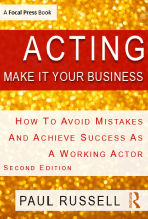
When I began writing ACTING: Make It Your Business one of my main goals was to write about what happens on the casting side of the audition table and the abuses that occur. Eventually I devoted a whole chapter to audition horror stories; not mine but actors who encounter rude auditors. And then how to react in the room during such occurrences. Having been an actor I was pissed-off by the behavior of some “casting gods”.
A casting director only has three people to answer to for their actions. Talent. Their client. Themselves. The last will either be the flaw or strength in that chain of command. For if the casting director is basically flawed in character then they will have no moral compass. If the casting director has humility, knows what is socially and professionally acceptable then they will treat others with the respect they would prefer for themselves. Beyond self-governing there is very little oversight from talent and the casting director’s client. Actors often don’t voice displeasure in response to a casting director’s treatment of them for fear of being black-listed. Clients are often unaware of what happens when not in an audition room with the casting director.
The unions for actors (A.E.A., SAG and AFTRA) have little to no authority over a casting director’s audition room behavior. Same goes for C.S.A. (which is not a union but a membership organization). The only entity, besides the casting director themselves, who can bring consequence is the casting director’s client; the producer. Only they can dismiss the C.D., terminating their service. As long as casting directors are not answerable to anyone but ourselves and our clients it’s only our professionalism and humanity that keeps an audition room from becoming a second layer of hell for actors.
My Best,
Paul
Read advice from legendary talent agents,
plus Hollywood & Broadway actors in Paul Russell’s Best-Selling Book ACTING: Make It Your Business!
Paul Russell’s career as a casting director, director, acting teacher and former actor has spanned nearly thirty years. He has worked on projects for major film studios, television networks, and Broadway. Paul has taught the business of acting and audition technique at NYU and has spoken at universities including Yale, Temple and the University of the Arts. He writes a column for Back Stage and is the author of ACTING: Make It Your Business – How to Avoid Mistakes and Achieve Success as a Working Actor. For more information, please visit www.PaulRussell.net.
 Answers for Actors
You must be logged in to post a comment.