When to Join an Actor Union? – Answers for Actors

I was heartened once long ago when sitting on a panel that included a Vice-President from Actors’ Equity Association who had said without reservation, “Being a member of Equity does not mean you’re a professional. That’s a myth.”

Paul Russell
Photo Credit: JackMenashe.com

There once was an impatient, young actor  hired as a non-union performer by one of my L.O.R.T. clients. The actor strongly believed that if he didn’t get his Actors’ Equity card by age twenty-one his career would be over.

I kid you not.

When hired he’d hit his self-imposed card deadline. During his contract at the union, regional theater he got his nose out joint when he wasn’t bumped up from ensemble into an understudy vacancy. So what was his reaction at his first, major, regional theater job? He sent a heated e-mail to the artistic director resigning his position. The artistic director called me. We were to go into auditions in New York and replace the soon-to-be departing peeved performer. This effort was going to cost a lot of money and time. I proposed a solution.

I contacted the actor and asked him what his problem was. He bitched and moaned about not being appreciated, and that his work in the ensemble was not fulfilling his ‘artistic soul’. He wished he were back in New York seeking work. This was during the employment doldrums of summer.

After hearing his complaints, and my not wanting to go into costly auditions, plus my desire to not want my client to focus on the discovery that they’d hired via my office a high-maintenance performer, I asked Mr. P.P. if he would stay the length of his contract if I could get the theater to offer him his union card at the end of his term. “Yes,” he replied without hesitation. The theater agreed. The actor stayed plus his contract was extended  earning him union work-weeks towards health insurance coverage.

But…

While the solution provided immediate gratification for all sides, especially Mr. Peeved Performer, it didn’t help him much past the near-term. Being young, green and an odd type he didn’t work much (nearly not at all) after that gig because he was now up against stronger, union performers. Had he remained level-headed and non-union for his early to mid-twenties he more than likely would have worked more often. Why? Because as a non-union talent he was more valuable. He had good dance skills, a fair voice, and enthusiasm. But those assets were paltry against the union performers who had many more credits, skill, and training.

Going union. Only in theater does this quandary seem to stymie participants in the performing arts as to when, why and how to join a collective barging unit. Especially since in the late ‘90s and well into the 21st century large-scale, non-union tours that looked identical to their Broadway parents (minus the Broadway budgets necessary to hire union talent on and offstage) began cutting into union work that was once a vital source of income for the theater artist. Then to compound that injury the deep economic crisis of the new century’s first decade which prompted many union houses in the regions to dump union contracts and agreements in favor of hiring a non-union, lower payroll in order to survive. Suddenly for the first time in decades the non-union artist had the upper hand for attractiveness in being hired. With a capital ‘C’ that stood for cheap it was commerce over competence that was (and continues to some degree) to be a major factor in who got work (non-union actors) and who remained unemployed (union actors paying union dues).

For each participant in the theatrical arts the ‘when’, ‘why’ and ‘what’ union varies. For some, joining a union is a status symbol. Recognition as being ‘a professional’. To which I reply; bullshit. Union membership does not equal professionalism.

I have witnessed many union actors, directors, designers, and stage craftspeople behave worse than the worst community theater artist. Many of the drama deviants make Waiting For Guffman look like Broad-way.

Also being union does not mean the person paying membership dues is a talented person of high regard. Need I mention some names of actors, directors and choreographers whose dreadful work has been seen while we all gasp and allege, “My dog could have done better.”

I was heartened once long ago when sitting on a panel that included a Vice-President from Actors’ Equity Association who had said without reservation, “Being a member of Equity does not mean you’re a professional. That’s a myth.”

Yes! Finally someone from that occasionally arrogant organization openly opposed the AEA mantra that the only ‘professional actor’ is an ‘AEA actor’.

Whatever union represents your field of expertise know that the initials that follow your name designating inclusion into the club will not make you better at what you do. Only you can do that; not a union card. Membership cards are generally plastic; an adjective defined as ‘synthetic’. Your career is more substantial. How you toil at your trade should not solely be reliant upon an identification card that is renewed only when you pony-up an annual payment to a union.

A union is for protection not perfection.

Pros & Cons of Becoming Union:

Pros:

–          Basic salary minimums set by each union

–          Health & Pension benefits (if employed a certain amount of weeks per year)

–          Arbitration should there be a dispute between the union member and his employer

–          Elevates professional status (but that doesn’t mean the talent rises as well. There are many union members who are outclassed by non-union talent)

Cons:

–          Less opportunities for work (unions forbid and fine members for accepting work without a union contract attached)

–          More competition (and often of higher caliber)

–          As a union member you cost the producer more to hire as they pay bigger bucks for your larger union salary, and also must pay into your pension & health payments funds.

For the theater artist there’s a lot of non-union work in the regions and on the road. The younger and greener (i.e. less work history) you are the less likely you are to work as a union performer. The actors who have a solid resume with numerous union and/or first class (Broadway and sit-down tours) are the actors who get the audition appointments over the newly joined union actor who has one or two credits at small regional theaters or summer stocks. Yes, the situation sucks but that’s life.

Going union is your call. But before you make the choice, when the card is offered, ask yourself the following questions:

Do I want to work?  Or do I want to work occasionally with the possibility of better pay and benefits? As a performer; does my age, skill set and experience equal my union peers?

If the final answer is ‘no’ then possibly reconsider your choice to stay and grow doing non-union work. You’ll become a stronger union candidate.

But eventually, the choice will always be yours.

My Best,
Paul
AMIYB_AmazonRead advice from legendary talent agents,
plus Hollywood & Broadway actors in Paul Russell’s Best-Selling Book ACTING: Make It Your Business!


Paul Russell’s career as a casting director, director, acting teacher and former actor has spanned nearly thirty years. He has worked on projects for major film studios, television networks, and Broadway. Paul has taught the business of acting and audition technique at NYU and has spoken at universities including Yale, Temple and the University of the Arts. He is the author of ACTING: Make It Your Business – How to Avoid Mistakes and Achieve Success as a Working Actor. For more information, please visit www.PaulRussell.net.

Bookmark and Share

E-mail This Post to a Friend or Two…

Get One-On-One:

Get New Insights:

Get The Feed:

Classes with Paul Russell Paul's book ACTING: Make It Your Business!

Answers For Actors Feed

Visit Paul @ PaulRussell.net and/or:

Paul Russell on Facebook Paul on Twitter Paul on MySpace

Why Actors Need to Be Idealistic | Answers for Actors

Idelaism
Paul Russell_HeadshotPaul Russell – author, director & casting director

What was your first role as an actor?

Were you a chorus member in a school musical? Were you costumed in a cardboard carpet roll representing an elm in a grade school pageant? Did you find yourself running towards the glowing circle of a spotlight’s beam cast upon the boards?

Or were you dragged, like me, unwilling, shy, and scared to place yourself before the public?

However you evolved into an actor your journey was soon propelled by a simple four letter word; love. Passion births idealism. Grasping firmly onto that fascination invokes our individual desires for success.

And with idealism, like the early romances of our youth, comes expectations of how things will be.

We see golden auras in each pursuit. Flaws are diminished by our doting on the excitement of the positives. As reflected when Sondheim scored: “Everything was possible and nothing made sense” when he wrote of elders reminiscing upon youthful aspirations in the musical Follies.

Holding onto that initial wonderment of freedom and barriers be damned is the greatest challenge to an actor. Lose your idealism and you lose yourself. Game over.

Idealism is both a burden and burro in our journeys as artists. We must lug the load of enthusiasm upon our backs when the trail rises. And we ride idealism’s joys on leveling plains and gentle rolling downgrades. The latter is the easier. The struggle to haul idealism over forbidding pathways is the swiftest and most destructive potential to ending one’s travels.

Dismissive civilians, un-supportive family and friends, and criticizing peers often weigh down our idealism by loading on our backs disparaging comments:

“What’ve I seen you in lately?”

“How come you don’t have an agent?”

“Why don’t you have a better agent?”

“Why aren’t you famous?”

“When will you grow up and get a real life?”

I endured those doubts dropped upon me when I was an actor. I still hear similar in my current work as an author, director and casting director. But mostly the damaging comments that lead to self-despair come not from others but from within ourselves:

What is my career? Where am I going? How much longer until I reach… wait… what am I reaching for? Do I know? I think so. But my sight is sometimes blurred by a blizzard of doubt.

Doubt from and to you kills idealism. You must murder the assailing dissent before it murders your dreams. Kill the doubt. To keep your idealism alive—that joy you had when first beginning your career—you must bring death to thoughts, words and actions that plot to annihilate your wonder for obtaining your goals.

If any of us are to succeed we must stop and recall during times of doubt why we first began our journey. What was the lighted joy that sparked our imagination so that we could see ourselves forward beyond perceived limitations? You need to shield that light close to you. Nurture its wick. Protect the flame from crosswinds that threaten to extinguish its glow. Once the light puffs out leaving a thin tendril of gray trailing there’s little chance of a rekindle. The flame may flicker during gales of despair. It’s then that idealism’s glow must be most guarded. Idealism is a beacon within your heart.

Often I’ve been battered by professional and personal tragedies. And with each new assault that leaves me nearly in fetal position I sort through the dark doubts and discover a tiny light flickering its glow upon a thought; ‘You’ve no other choices discovered yet that bring you the same happiness… get up, push forward and find the fourteen year-old you who was pulled unwillingly onto the stage and found a home.’  That adolescent’s discovery was and remains my idealism.

What’s yours?

Do you still have it?

Is it flickering? If so, guard it.

No one else but you will lantern the light that is your idealism.

My best,
Paul

For many, many more actor marketing tips plus audition room technique, and how to best find and keep agents get that vital information from the people who know it best: Broadway and Hollywood actors, agents and casting directors speaking to you from the pages of the book the casting director for Hamilton, The Intern, The Wiz – Live hails as:

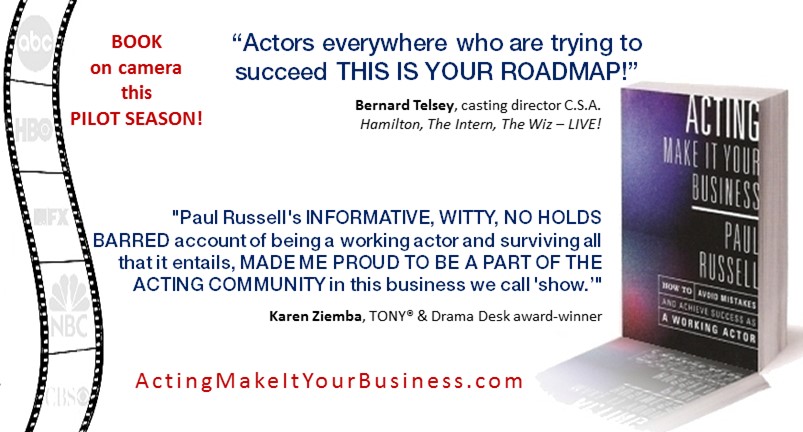
“Actors everywhere who are trying to succeed in the business, young or old, on stage or on camera, anywhere in the world, take note:

This is your roadmap!”

BERNARD TELSEY, casting director – CSA
(The InternHamiltonNBC’s The Wiz – LIVE!, Wicked)

Get Paul Russell’s best-seller for actors; ACTING: Make It Your Business – How to Avoid Mistake & Achieve Success as a Working Actor

Share this:

Paul Russell’s career as a casting director, director, acting teacher and former actor has spanned over thirty years. He has worked on projects for major film studios, television networks, and Broadway. Paul has taught the business of acting and audition technique at NYU and has spoken at universities including Yale, Temple and the University of the Arts. He is the author of ACTING: Make It Your Business – How to Avoid Mistakes and Achieve Success as a Working Actor. For more information, please visit www.PaulRussell.net.

Casting Directors, Talent Agents, Directors & Actors

Love Paul Russell’s Best-Selling Book for Actors
ACTING: Make It Your Business!

“All the right questions asked and answered…
and with a generous portion of good humor.”
SUZANNE RYAN, casting director, CSA
(Law & OrderUnforgettable)
“I love this book!
Paul’s book tells you what you don’t want to hear but really need to know
EVERY actor should read this book!”
DIANE RILEY, Senior Legit Talent Agent
Harden-Curtis & Associates
“Paul’s book made me proud to be a part of this community we call ‘show!'”
KAREN ZIEMBA, TONY & Drama Desk Award Winning Actress
“Paul Russell’s words are not only blunt & accurate they zero in on all the questions every actor wants to know but is afraid to ask!”
KEN MELAMED, Talent Agency Partner
Bret Adams, Ltd.
“I had my Business of Acting, BFA Seniors, class do book reports on a variety of “business of acting” books and ACTING: Make It Your Business came out a clear winner—considered to be essential for their bookshelves!
Dr. NINA LeNOIR,
Dept. Chair – Dept. of Thtr.
Chapman University

Get smarter on the business of acting from legendary Hollywood & Broadway actors and talent agents in a casting director Paul Russell’s Best-Selling Book ACTING:AMIYB_Amazon Make It Your Business!

Paul Russell’s career as a casting director, director, acting teacher and former actor has spanned nearly thirty years. He has worked on projects for major film studios, television networks, and Broadway. Paul has taught the business of acting and audition technique at NYU and has spoken at universities including Yale, Temple and the University of the Arts. He is the author of ACTING: Make It Your Business – How to Avoid Mistakes and Achieve Success as a Working Actor. For more information, please visit www.PaulRussell.net.

Bookmark and Share

E-mail This Post to a Friend or Two…

Get One-On-One:

Get New Insights:

Get The Feed:

Classes with Paul Russell Paul's book ACTING: Make It Your Business!

Answers For Actors Feed

Visit Paul @ PaulRussell.net and/or:

Paul Russell on Facebook Paul on Twitter Paul on MySpace