Actors Having The Career of Their Desire | Answers for Actors

“You’re an actor? What might have I seen you in?”

When I was an actor I hated being asked that question by civilians. Because I knew that their short-sighted knowledge of ‘what it means to be an actor’ equaled a walk on the red carpet, encored by an acceptance speech, then followed by a month in rehab.

Paul Russell
Photo Credit: JackMenashe.com

“You’re an actor? What might have I seen you in?”

When I was an actor I hated being asked that question by civilians. Because I knew that their short-sighted knowledge of ‘what it means to be an actor’ equaled a walk on the red carpet, encored by an acceptance speech, then followed by a month in rehab. My earlier career as a continually working actor included carpets in cast houses stained red by wine, accepting paltry payouts masquerading as salaries and a month rehabilitating my self-esteem after walking into an audition donning a cow costume. (Long story. Don’t ask. But I got the gig plus much additional employ as a result… but you’ll never get the embarrassing bovine details outta me. Never.)

Any, non-deluded, active participant in the arts whether actor, writer, director, designer or production member hopefully understands that their career is not about fame but the work. And that that employ will not be steady nor long-term.

But civilians who look to the fables of HBO’s Entourage and our industry’s other self-inflicted emasculation believe that for one to brand themselves as ‘actor’ that harpy of Hollywood, Broadway or the West End  must be recognizable. In the civilian’s loopy logic an actor can not be an actor unless said actor is attached to notoriety. Odd how the civilian working the counters of McDonald’s or the register of a Walmart retreats from their own association with employment notoriety.

When I was a working actor encountering the “What might have I seen you in?” interrogation I often wanted to reply questioning the civilian, “Oh, so you’re a receptionist? For what Fortune 500 Company exec do you gopher coffee? What desk might I have seen you in?”

Civilians, and too often our families and non-arts friends, will never comprehend that working in entertainment does not necessarily produce a career of glossy exposés on TMZ or ferried limos to premieres and opening nights. Often career-in-the-arts pursuers are driving limos and working letters online to solve next month’s rent due.

Beyond my accepting that civilians have for far too long been brainwashed by those of us who’ve moved into the hot white glare of entertainment; writing, directing and acting in distorted mirror imagery falsely defining the majority of employ in the arts I’ll never get why civilians overlook the obvious– not every actor, writer or director can stand in the tiny celebrated circle of being number one. Just as in the civilian’s own tedious toil of whatever employ is theirs. Not every data entry operator will be heralded as the World’s Fastest Typist in the Guinness World Records.

Not every actor is going to be continually employed at their love’s art. Who would comb crumbs from our tables at Ruth’s Chris Steakhouse or pour our rum and cokes at Friday’s?

Not every actor is going to be a principal on screen or on Broadway. Odd how civilians (and a number of actors themselves) over look that stages and screens are filled with bodies that speak and engage the audience and those communicating corporeal forms are not always celebrities. There are journeyman actors like James Rebhorn and Phyllis Somerville (see Acting: Make It Your Business). Acclaimed industry actors not known by name in the rural reaches and sub-divisions of suburbia. But each artist has worked hundreds of major (and minor) screen and stage projects as principals. Are journeyman actors any less an actor because they’re not a household name in Des Moines?

As an artist you shouldn’t live to be the career that others project or desire upon you.

How do you define your career? Happiness? Sense of accomplishment? Earning money to meet basic needs? Or is career success defined as being recognized by many? If that latter definition is the prevailing opinion within your cranium, a premise held by many civilians, I would then counter argue to that limited measurement that our spinning ball of dirt and sea is over-run with failure. And I’d bet several truckloads of Tastykakes that a majority of the world’s populous would take umbrage at such an assessment. Do you consider yourself a failure because your stint in a play in New York or Naples, Florida wasn’t recognized by the populous of Hoboken or Houston? Is a doctor in Nappanee, Indiana any less a success to his/her patients because Chicago medical professionals never heard of the farmland doc?

Do not let others dictate definition of your career. Too many actors are guilty of limiting upon themselves the scope and definition of their success. And some actors not only wound themselves with doubt because they believe success as an actor is a walk on the red carpet but they foist the same delusions upon their peers as well.

I, as a director, casting director and author, encounter the civilian query… but mostly by actors in the form of, “What have you done lately?” My answer is almost always, “I’m keeping busy.”

A single credit in any one of my career pursuits does not globally define my success. I define my career as, “I’m doing what I want, must, and just as importantly engaging in work that keeps me from the grave.” If that answer for my career doesn’t meet the expectations of others… I’m not living for their desires I’m living for myself and those I love.

There is only person’s career expectations to which you’re bound: You.

Side Note: Free subscriber to Answers for Actors? If not, then you’re not getting Answers for Actors delivered directly to your in-box. Each new post (once to twice every two weeks) gets you industry info. I and my office do not view your e-mail address when you subscribe (the techno-elves do all that).  We just know you’re on-board and happily sharing in your journey. To subscribe for free use one of the subscription services to the lower right.

My Best,
Paul

Paul Russell’s career as a casting director, director, acting teacher and former actor has spanned nearly thirty years. He has worked on projects for major film studios, television networks, and Broadway. Paul has taught the business of acting and audition technique at NYU and has spoken at universities including Yale, Temple and the University of the Arts. He writes a column for Back Stage and is the author of ACTING: Make It Your Business – How to Avoid Mistakes and Achieve Success as a Working Actor. For more information, please visit www.PaulRussell.net.

Bookmark and Share

E-mail This Post to a Friend or Two…

Get One-On-One:

Get New Insights:

Get The Feed:

Classes with Paul Russell Paul's book ACTING: Make It Your Business!

Answers For Actors Feed

Visit Paul @ PaulRussell.net and/or:

Paul Russell on Facebook Paul on Twitter Paul on MySpace

Actors: Getting Seen Virtually Everywhere | Answers for Actors

Those actors who still dismiss and piss, “I’m an actor. I got my headshot. That’s all I need.” will have a lonely existence with their puss on photopaper as sole companion.

Paul Russell
Photo Credit: JackMenashe.com

You may have recently heard distant screams. From whom and where did the howls emanate? Moi.

Why?

I was entrenched in a technological, extreme makeover (minus an aging twink bullhorn host) of PaulRussell.net and ActingMakeItYourBusiness.com.

Your career success and advancement as an actor is related to my past wrangle with advances in confusing HTML5, multiple viewer platforms (computers, phones, tablets), and browser battles between Internet Explorer, Firefox, Google Chrome, Safari, Opera (Aaaaaghhhh please, please stop the browser insanity… we just want cheap air tickets, post Facebook chain-status-pleas for recognition of dust bunnies as an endangered species, and an occasional dark, dabble into porn while the cat and/or dog sleep!).

How? you may be asking yourself doubtful, readying your finger dismissively towards the little close-out ‘x’ of this window. Why could your career fly or founder based upon web scripting insanity? Simple.

Because the marketing of your career to casting, talent reps., producers, directors, (hell this entire spinning ball of dirt and sea if your sights are so ambitious) depends on your understanding where Internet and mobile connection technology has now – for better or worse –  dumped… (pardon, let me not be a bitter bytes bitch) transported us. How are you being seen online (if at all) around the world to industry? If you have a website… are you absolutely certain what you see on your screen is the also being displayed on screens everywhere? Don’t be so sure…

Regular readers of Answers for Actors and my Random House / Back Stage Books read ACTING: Make It Your Business know well that every actor needs a website. Those actors who still dismiss and piss, “I’m an actor. I got my headshot. That’s all I need.” will have a lonely existence with their puss on photo paper as sole companion.

As an actor you’re a business. A business must advertise its wares. You’re the CEO and employee of your business.

If you haven’t gone beyond YouTube, Facebook or Actors Access to spread digital word of your existence… how’s that weekly unemployment check-in doing ya?

Now if you have a web site. Yay! But…

Is your website cross-browser readable/compatible?

Can a web-surfer who insists on the archaic technology of Internet Explorer enjoy the perfection of your Internet presence found via techno-trend forward browsers like Firefox and Google Chrome?

(Side note to I.E. devotees: Internet Explorer is not your boyfriend. You can break the addiction to the backwards browser experience and join the present with the better web browsers of Firefox, Google Chrome and alike.)

Because technology titans behind various browsers are warring for audience share each provides (or withholds like Internet Explorer) varying versions of website page views. The reasons for and why are too far filled with a bunch of techno-babble so let’s move on…

Varying Browser Views:

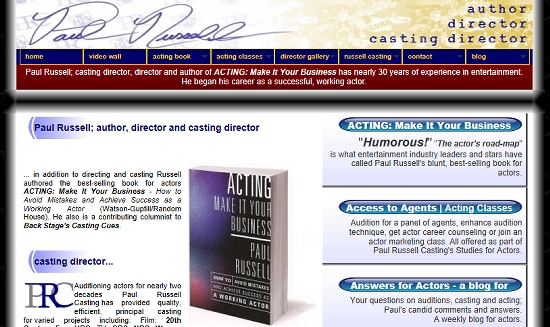
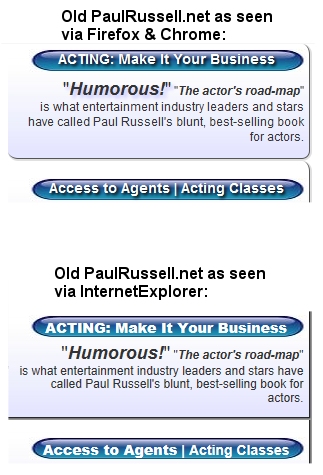
With my now deceased, old website (2008 – 2011) visitors, depending on which browser utilized to surf for their Internet desires, either enjoyed the website as I wished or were forced to view an unwelcome stiff version.

Screen Shot of Old Site as it was Intended to Be Viewed (Firefox, Google Chrome):

Screen Shot of Old Site as it was NOT Intended to be Viewed (Internet Explorer, Safari):

You may not immediately detect the differences but they’re there.

In the intended view as displayed on Firefox and Chrome browsers (directly left) the blue boxes are rounded. The text in the links ‘ACTING: Make It Your Business’, ‘Acting Classes’ and the word ‘Humorous’ display a shadow effect.

Where as in the stiff Internet Explorer display (below left) there are no rounded corners, no shadows, sloppy font face and a myriad other defects to horrible for this pesky-picky Virgo to admit.

When you’re designing your website, or if you have someone do such for you, view the results in various browsers and make adjustments as needed so that the majority of your visitors see your original intent. Web building software like Dreamweaver provides multiple browser viewing as you create. So you needn’t have your byte baby be embarrassed in public. You can fix digital deformities well before you place your child onto Internet pageantry.

Is Your Website Multiple Platform Friendly?

(Say what Paul?????)

O.K… in plain speak… can a visitor easily view and navigate your website across all devices? Windows on the web that include; cell-phones, smart-phones, tablets, and home computers/laptops.

When you’re surfing on your mobile device for your next hot date or purchase of a gift for a forgotten anniversary you may notice that some websites require you to enlarge, shift the screen, or move your fingers across your mini-device like a mouse in a maze. Why? The website’s designer didn’t deliver the site compatible for media queries.

(What the fuck did Paul just say????)

Sorry… plain speak again. Media queries = website was designed to be fitted and viewed for varying screen sizes (phones, tablets, desktops).

My 2008 web design was launched shortly before the eruption onto the market of smart-phones and tablet technology. Visitors utilizing those devices saw… (oh, this is embarrassing) the following unintended digital devastation of the former PaulRussell.net viewed on a cell-phone:

The site did not fit cell-phone screens.

As I am oft to say to actors, “This industry is all about image, image and image.” And well… I wasn’t doing so hot in the image department when it came to my aging website being viewed beyond the screen of a desktop.

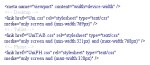
When designing and/or retrofitting your web site you’ll need to ensure that it can be easily viewed and navigated on all devices. This will require a lot of CSS (Cascading Style Sheet) trickery. And a bit of behind-the-page scripting:

That mangle of near hieroglyphics to the right which is causing your brain to freeze in confusion while your heart pounds a Salsa beat is HTML– text-commands that keep a page like this one in order. And for multi-platform viewing of your website you’ll need separate Cascading Style Sheets for each device your website will be viewed.
(Whoa, whoa Paul… slow down… I’m as lost as an Amish in a bathhouse.)

Plain speak…

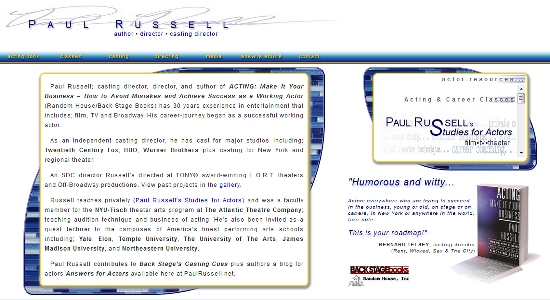
In retooling PaulRussell.net I had to literally rebuild each page thrice (changing styles to accommodate screen size, move objects and text) so that a single page could be viewed and navigated on multiple devices:

New PaulRussell.net as seen on a desktop:

New PaulRussell.net as seen on cell-phone:

As displayed above the appearance between desktop and cell-phone views vary. While I was aggravated creating each cell-phone variation of a page in the end the smaller-window viewer has a user-friendly experience.

Drag-n-Drop Websites:

Intuit and similar website building services offer a drag-n-drop building experience where you needn’t know CSS or HTML. And better, the services almost always automatically translate your website for multiple media queries. So you needn’t fret with sweat.

Self-build Websites:

Dreamweaver and similar website building software offer solutions for media queries but you must, by finger, do all the work. And to the disappointment of many techno-geeks the new Dreamweaver Cs5 has minor bugs and glitches. Such as you make a change to a design element and Dreamweaver refuses to display the change even though your Virgo-like perfectionism knows you’re right and that you did the work. (Yes, that was one of the causes for my howls you may have heard echo over the past month.)

HTML5 & Flash:

The two technologies are like the cowboys and farmers in Rodger’s and Hammerstein’s Oklahoma; they ain’t friends. Aunt Eller ain’t got a bouncy ditty to bring the two together.

Flash which was the techno darling of the late ‘90s and early aughts of this century is now becoming the bastard child of media delivery (online videos and music). Flash is not recognized on many tablet and mobile devices. HTML5 (a newfangled, scripting reducer upgrade in web page layout) has replaced Flash media options. If your website presently contains any Flash a growing percentage of your visitors will not be able to view your reel or listen to your voice-over demos. You’ll need HTML5 video and audio options.

(NOTE: PaulRussell.net is in the process of retooling. Flash temporarily remains on the audio interviews on the media page as this author struggles adopting the learning curve.)

YouTube to the Rescue!

YouTube has upgraded to HTML5. So that when you embed your reel from YouTube onto your web site; everyone on every device can view your work. But…

YouTube places advert banners across the bottom of videos. Viewers could be lured away from your work as they click upon an ad promising overnight stardom via a $10,000 tuition to a shopping center performing arts ‘academy’. The choice of utilizing YouTube or struggling to create a HTML5 compatible video player is yours.

O.K. I sense the glazed-over, overwhelmed technology paralysis. Breathe. But don’t ignore. If you call yourself an actor you need a website. A domain that includes your name dot whatever. There are many options to creating an online presence that is professional quality.

Easiest: Hire someone.

Pros: You don’t have to drown in digital drivel.

Cons:   Cost.

You will not have independence to instantly update your site when needed.  And often you’ll have to pay your website builder extra for each new update.

Moderately Easy: Drag-n-drop web site building

Pros:    You have some creative and update freedom.

Cons:   Your site, built on a template, has the risk of looking boxy and/or a near     mirror reflection of other people’s web sites built with upon same interface.

Rewarding Challenge: Self-build

Pros:    Independence. You can change, update at will. You’ll have learned new skills that could be leveraged for earning additional income.

You’ll have an Internet presence as you want it.

Cons:   If presently virgin to HTML and CSS you’ll need to be patient with yourself as you learn the technology and make mistakes. But you’ll also learn successes and you’ll get a boost in self-confidence.

Upgrade and/or build. The river of technology has a swift current. The longer you stand upon the shore in doubt, the quicker you’ll witness your peers sail past you.

Take a whirl around the new PaulRussell.net and/or ActingMakeItYourBusiness.com. There’s been changes a plenty.

Side Note: TWO bi-coastal, Legit agents (one an agency owner) join a third agency owner for 2011’s final Legit (TV, film & Theatre) Access to Agents. Special registration ENDS this week. What’s Access to Agents? Who got agents and work as a result of participating? Details @ http://paulrussell.net/Access_to_Agents_TVandFilm.html.

My Best,
Paul

Bookmark and Share

E-mail This Post to a Friend or Two…

Paul Russell’s career as a casting director, director, acting teacher and former actor has spanned nearly thirty years. He has worked on projects for major film studios, television networks, and Broadway. Paul has taught the business of acting and audition technique at NYU and has spoken at universities including Yale, Temple and the University of the Arts. He writes a column for Back Stage and is the author of ACTING: Make It Your Business – How to Avoid Mistakes and Achieve Success as a Working Actor. For more information, please visit www.PaulRussell.net.

Get One-On-One:

Get New Insights:

Get The Feed:

Classes with Paul Russell Paul's book ACTING: Make It Your Business!

Answers For Actors Feed

Visit Paul @ PaulRussell.net and/or:

Paul Russell on Facebook Paul on Twitter Paul on MySpace