
This week: The Stench of Desperation; Actors Trying too Hard
 You and I both know how difficult the challenge often is to garner attention in our business. I’m speaking of positive, career-forward recognition, not the Lindsay Lohan lapses of judgment.
I’ve written in my book and spoken in classes of past gimmicks of actor ‘Look-At-Me!’ foibles that I and my colleagues have come upon. Ranging from footwear bribery, attempts at culinary collusion for a callback to cereal boxes loaded with an actor’s reel hidden deep within the cornflakes. (It’s not the children of the corn that are always the flakes.)
So, yes, I and many casting directors, talent agents, artistic directors, directors, choreographers, managers, producers, anyone who gives the nod of affirmation for employ has seen their share of actors trying too hard to gain attention. And there’s a single word for this act; desperation.
That noun describing an action or state of despair once displayed is difficult to remove from the memory of those who witness it. Kind of like the stench from when having a run-in with a skunk. The odor of desperation follows you. And sadly, people who make attempts for attention don’t often see themselves as coming across as desperate. With noble intent they charge forward in a manner that turns off their objective. Think of one of your past loves who whined or were needy for you and how disenchanted you became of their arduous affections. They, with a heart full of great desires, were desperate. The cause? For each scenario that differs. Sometimes fear of failure lures one to desperation. But often insecurity is the main culprit that leads the innocent into committing an act of desperation.
While casting for the national tour of The Diary of Anne Frank my office received possibly one of the more misguided attempts to gain attention and an audition appointment. Below are images of her cover letter. The actress’ name I’ve altered for privacy. Sadly the burn marks made by the sender for make-believe-authenticity are authentic to the actress.
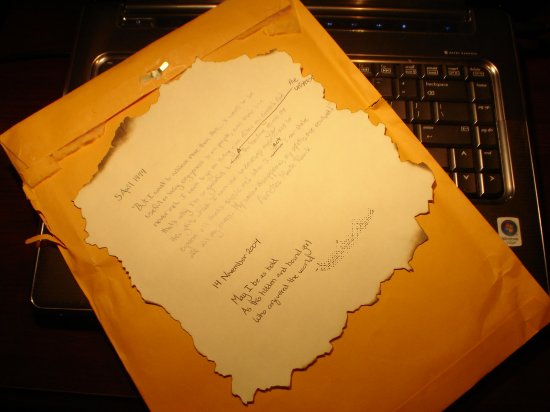
Now take a closer look below and you’ll see that the actress, in attempt at making her cover letter look as if it were ripped from Anne’s diary, was summoning the departed victim of one of mankind’s darkest hours.
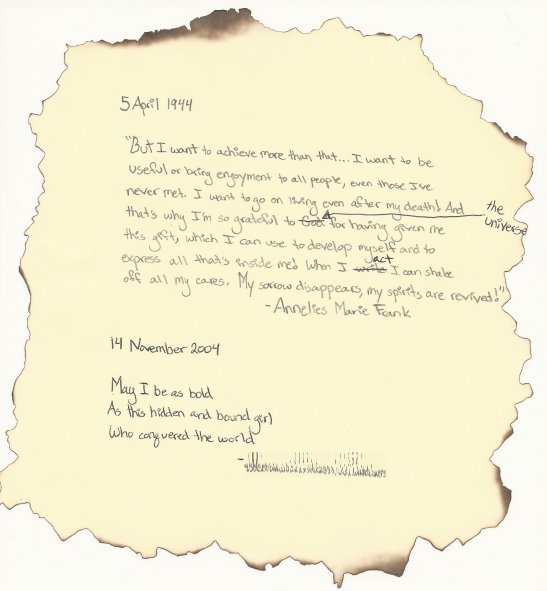
The actress’ intent went beyond desperate to bordering on an obsessive passion for the real-life character.
Entertainment is a business. When pursuing the employ of fantasy the pursuit should be as professional as with your approach to finding your survival jobs. I doubt that you would (and hope that you would not) send a query letter for employment like the above to a Fortune 500 company, the Trump Organization or any civilian employer.
My partner, the talent agency owner, recently received an 8”x10” mailing (below) from an actor that could be interpreted by any recipient to be another act of desperation for attention. Now, the young man probably did not perceive such as he spent many hours and monies upon marketing that he believed to be professional and slick:

Yes, it is a bit polished. No, you should not do similar. As a comp card? Possibly. As a headshot and resume which the above was intended to be? It’s too slick for our purposes. It and the actor try too hard. Less is more. A simple headshot with on the back a résumé printed on clean, crisp, white paper. That package would have been more effective and apropos.
But it wasn’t just the irregular P&R format that caught my attention. There was also a lengthy, five-paragraph, cover letter full of prose containing near nothing as to valuable, substantial information like; education, past projects, and people he has worked and/or studied with. Much of the content mirrored the following phrase:
“Throwing my headshot into the trash can would be a mistake… some agent is going to make a lot of money.”
Oh, no he didn’t. But oh yes he did.
Now you may be formulating the following thought, But Paul, he got your attention. Yes. Yes, he did. But it’s not the kind of attention I believe he wanted. My initial reaction was, “My God, how much time and money did this young man spend to put together a mailing that overcompensates for lack of substance in his work history?” He was trying too hard to make up for a thin resume. Of which the latter (a thin resume) is not a crime or fault.
I and my colleagues would be thrilled to see the exampled actors here (and similar like them) succeed by making professional-in-appearance choices in their journeys instead of driving down dead-end driveways of desperation. I give hardball tough love here, in my book and in classes because I honestly want success for every actor I encounter. Their success is my happiness. Not because I arrogantly believe myself to be right but because I don’t enjoy seeing actors fail as a result of simple mistakes they have made. Overcompensating is one of those easily tripped upon errors.
We all begin with nothing. Be proud of what you have to offer. Don’t subjugate substance for splash. Don’t go Six Flags fireworks on your resume to overcompensate for a mom-n-pop history. Some of the most productive producers of story-telling art have been those lesser known venues. Never be ashamed. (And unless you want to permanently destroy a cover letter never take a match to your missives.)
You know where we all should be trying too hard? At enjoying life. Living to our fullest potential has no odor of desperation.
Besos,
Paul

<a href="http://www.stumbleupon.com/submit?url=&title=”>
E-mail This Post to a Friend or Two…
Paul Russell’s career as a casting director, director, acting teacher and former actor has spanned nearly thirty years. He has worked on projects for major film studios, television networks, and Broadway. Paul has taught the business of acting and audition technique at NYU and has spoken at universities including Yale, Temple and the University of the Arts. He writes a column for Back Stage and is the author of ACTING: Make It Your Business – How to Avoid Mistakes and Achieve Success as a Working Actor. For more information, please visit www.PaulRussell.net.
Get One-On-One: |
Get Work: |
Get The Feed: |
 |
 |
|

Visit Paul @ PaulRussell.net and/or: |
||
 |
 |
 |
 Answers for Actors
You must be logged in to post a comment.