

There are private answers for actors you never see. Time to reveal…
Almost daily, I get e-mails from actors asking questions. If time (and brain clarity) permit I’ll gladly answer.
Below are 10 tips for an actor’s career — exchanged via e-mails — that you haven’t seen. My one-on-one with actors, offering advice to better their careers in entertainment:
Contacting Talent Agents:
Paul, I’m compiling a list of agents and casting directors to send my headshot/resume to. Is it recommended to send packets to one person in the office or all? Thank you for the attention. George M.
Hi George,
Best to target one agent in the office.
Most offices have an assistant open the mail. It’s that assistant who decides to pass along your materials. If an actor sends more than one mailing to multiple agents in an office that assistant will often trash the additional copies and pass along only one copy of the actor’s materials.
If after your first round of mailings there is no response; try other agents in the office. Wait at least a month.
Now (pilot season) is the worst time of the year to do a mailing; agents and casting directors are focused on their projects. Wait until April, May, or summer and fall which are the best times to target agents.
Actors as Extras & The Actor’s Resume:
Paul, I teach at the University of Albany using your book as a text. A student of mine had a question. Below is his question and my reply:
From Student: Quick question, should background and stand-in have their own categories on my acting resume?
My reply: If your resume is still a bit thin, then for now you can include them under FILM or TELEVISION headings. Just be sure, in the ‘role” column, that you list your contributions to the project truthfully, be it ‘Background’ or ‘Stand In’. Once your resume starts to fill out. then lose these credits. . .
Any hints Paul on how to better answer this type of question would be appreciated! Many thanks- Yvonne P.
Hello Yvonne,
Thank you for the note. I’m happy to learn ACTING: Make It Your Business is part of your curriculum.
You’re near spot on about listing Extra work on a resume. Unfortunately because of a stigma of Extras (created by some over zealous Background Actors) and because Extra work is more about look and warm bodies than talent; listing the credits drags down a resume. But as you know we all begin with a blank page. Your advisory to the student is the best advice for this point in his/her career.
Several months ago I wrote a blog about Extras (That Extra Smell – Which Actors Have It).
I wish you and your students well. If ever you’d like me to visit to work with the students drop me a note. I enjoy visiting universities and working with the actors.
To Give-Up or Not to Give Up? / Actor Self-Deportation:
Hi, I’m currently wondering whether to try once again working in the ‘industry’ or just leave the country for good and find a proper job back home? What do you suggest? Cheers. Francisco.
Hi Francisco,
You ask a tough question.
Without knowing your talents (in person), your history, your goals, your strengths, your challenges and overall state-of-mind (which would require more than just font-based words); I can’t give you an informed opinion. Similar as to a car mechanic being told by a car owner, “My car’s not working right.” the mechanic would need to evaluate the car directly to discover solutions.
Also; the question you ask has no answer from an outsider. You really need to ask yourself what you want; what are your hopes, ambitions and desires? No one can give this answer but yourself. The best person for the advice you seek is you. You know best your strengths, challenges and frustrations. Ask yourself. But don’t follow the immediate response. Give yourself time to consider alternatives and consequences of your instinct.
An Actor’s Resume:
Hi Paul,
Two things. One, I just read your article about the cantankerous casting director and was relieved to know there are people like you who are actually in this business to encourage actors. I thank you for that. I appreciate you sharing your perspective and giving us the helpful tidbits that will keep us all going.
Second, I have a question. I’ve been a professional actor for 16 years. I’m a member of both SAG and AFTRA and have no day job. Yes, I make my living acting. With that said, I live in a small market that has very few film auditions and even fewer female roles when there are actual films being shot locally. So, while I’ve been supporting myself and my daughter for years and have a plethora of on-camera experience, my list of films is short. As a casting director, when you see a resume that is light on films, do you automatically assume a person is inexperienced? Thanks again for writing and I do plan to sign up to hear more from you! Nancy T.
Hi Nancy,
Thank you for the kind note and compliments. Much appreciated.
With this business being very subjective I can only speak for myself when I’m presented a resume with few or no film credits. My reactions cover a multiple of reflections; the actor hasn’t had opportunities, the actor may be lacking in skill, or simply… the actor is just one among many of the competition fighting for a job.
Everyone begins with a blank resume. Everyone trudges along at the start with a resume thin on credits. Other than an actor honing skills and marketing the hell out of their business which is acting… there are few, other, proactive options for the actor. Luck is the major remaining factor to filling a resume.
Demo Reels & Actors Access:
Hi Paul,
I have my demo reels on my website and I’m actually in the process of making a new one, is it important to have it on Actors Access? I don’t have it on now but when I submit I usually leave a note to check my website and I just am not getting a lot of auditions. I know there are probably a ton of actors submitting to the same stuff. I was just wondering if having a reel on the actual Actors Access profile is what makes a casting director even want you to come into an audition. Thanks Paul!
Maggie M.
Hi Maggie,
The best answer I can give is this… think of yourself as the casting director. What’s the easiest way for them to see your reel if they are on Actors Access?
As an actor you must think of yourself when you’re a consumer. Do you like websites that try to sell you something but to make the full buy you must click onto another website? Or would less clicking be better?
Also, on Actors Access — owned by Breakdown Services which 99% of casting directors and talent agents daily utilize – actor videos are featured on the login page for casting directors and talent reps. If your video(s) are not on Actors Access, you’re giving an advantage to your competition (peer actors).
Actors Crashing an Audition:
Hi Paul!
Is showing up without an appointment something that is a horrible idea, frowned upon, tolerated or encouraged? Based on the number of people I’ve seen do it at auditions I am assuming it does happen at Equity and/or agent submission appointments, but I could be wrong.
I look forward to hearing your thoughts!
Alisa
Hi Alisa,
Crashing an audition (covered heavily by agents and actors in ACTING: Make It Your Business ) is generally something — at the B’way and studio level of the business — that is not welcomed. But… as Broadway actor, Michael Mastro explains in AMIYB he’s used tactics that have worked for him. And if something like he does works; great for all involved (if the casting people are open to the crash).
DVDs & Digital Marketing Submissions:
Hi Paul!
I recently auditioned for the Chorus Line, non-union, National Tour. I did pretty well, but got cut after learning the opening combination. I was going for the role of Maggie and come highly recommended by the Broadway professionals I have worked with, including Charlotte d’Amboise who just directed me in the role. I know if I had gotten a chance to sing maybe I would’ve been received better. Is it completely against protocol to send a reel of me singing ‘At the Ballet’ to the casting director with a note? Is there anything I can do in this situation? Or just wait for the next time around? Thanks so much!
Jessica H.
Hello Jessica,
Thanks for the note.
Never be hesitant in pushing yourself regarding your marketing. Send the video, but know this; most casting directors don’t open their own mail an assistant or intern does. So your video may or may not make it to the desk of the CD. And once on the desk there is no guarantee it’ll be viewed. But, you can at least have the satisfaction of never having to say to yourself “I should have sent something.”
My Best,
Paul
Paid Auditions / Seminars:
Is it a conflict of interest to have to pay agents and casting directors to audition for them. I’ve been dues paying SAG, AEA, AFTRA member for years (OK so I’m world famous in Rockland and not NYC) but they won’t see me. Makes me wonder … Duh! Crappy business. Thanks, Judy.
Hi Judy,
I covered paid auditions extensively in ACTING: Make It Your Business. Not only my perspective but also from agents and working actors as well. Each had their own strong opinions.
I still feel uncomfortable with them despite holding them myself. But I alleviate that personal discomfort by offering three weeks of marketing and audition tools to my students rather than the standard hit-and-run-audition seminars. The general, ‘paid auditions’ are now the most effective way of displaying your talents directly to agents. I know many actors personally who have gotten signed by agents and/or jobs from attending my and other paid seminars.
New York or LA; Which is Better for an Actor?:
I’m currently reading your book and it’s giving me such great advice, thanks for it. I just had a quick question, I’ve always wanted to be an actor in film so which place is ‘better’ for that between NYC and LA? Just to fill you in, I’m not a kid that just wants to hit the ‘Get me famous now’ button or anything like that. I’m willing to do the work, I just need some advice in the right direction. Thanks so much for your time.
Thom
Hi Thom,
Thanks for the note and kind words.
Your question is not an easy one to answer but I’ll try offering a bit of what I’ve witnessed over the years.
Actors with screen ambitions who do better in LA have one or more of the following:
An agent
Past film/TV credits
They’re young and/or ‘LA’ hot
They’re a unique, instantly, definable character
Actors with screen ambitions who go to NY first do so because:
There is an active screen community with film and episodics shooting in NY
An actor has more opportunity to keep their acting skills in shape by doing theater in NY (from Off-Off Broadway to larger venues)
NY allows an actor to build credits to transfer to LA with
There are no absolutes to any of the above. This business is like gambling; ya never know if you’re going to win or lose. You keep playing at your best and try to beat the odds.
Whatever your choice, NY or LA, I wish you great success.
And tip 10… (Applicable to all)
My own question I ask of myself often, “Why the hell do I direct, teach, and write?”
Answer; I know nothing better (at present) which doesn’t feel like ‘work’.
If ever you find yourself continually bemoaning your career participation as drudgery — whether its auditions, the need for continual training to expand your abilities, rehearsals, networking, and performing — then time to move on. You’ve abandoned the love.
My Best,
Paul
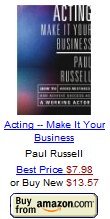 Read advice from legendary talent agents,
plus Hollywood & Broadway actors in Paul Russell’s Best-Selling Book ACTING: Make It Your Business!


E-mail This Post to a Friend or Two…
Paul Russell’s career as a casting director, director, acting teacher and former actor has spanned nearly thirty years. He has worked on projects for major film studios, television networks, and Broadway. Paul has taught the business of acting and audition technique at NYU and has spoken at universities including Yale, Temple and the University of the Arts. He writes a column for Back Stage and is the author of ACTING: Make It Your Business – How to Avoid Mistakes and Achieve Success as a Working Actor. For more information, please visit www.PaulRussell.net.
Get One-On-One: |
Get New Insights: |
Get The Feed: |
 |
 |
|

Visit Paul @ PaulRussell.net and/or: |
||
 |
 |
 |


 Answers for Actors
You must be logged in to post a comment.