
When is going from a non-union actor to a union actor best? Each actor has their own journey to one of those favored union cards be it from Actors’ Equity Association, SAG-AFTRA, or AGVA or all three: the triple crown of union status.
Once there was an impatient, young actor hired as a non-union performer by one of my L.O.R.T. clients. The actor strongly believed that if he didn’t get his Actors’ Equity card by age twenty-one his career would be over. When hired he’d hit his self-imposed card deadline but we hired him as a non-union performer (the producer’s budget dictated the necessity of a non-union actor to work alongside AEA actors). During his contract at the AEA theater he was miffed when he wasn’t bumped up from ensemble into an understudy vacancy. He threatened to quit. I intervened. We offered him his AEA card to remain.
While the solution provided immediate gratification for all sides, especially for the actor, it didn’t help him much past the near-term. Being young, developmental (i.e. new to the business), and a physical type that isn’t easily marketable for an actor he didn’t work much (nearly not at all) after receiving his AEA card. He was competing against stronger-skilled, union performers. Had he remained non-union for his early to mid-twenties he more than likely would have worked more often. As a non-union talent he was more valuable and desirable to union houses that hire non-union. Plus, he could work the lucrative market of non-union tours. I know of a good number of actors who played a non-union tour of a Broadway musical, and then were “upgraded” to making their Broadway debut in the NY counterpart of the show. Union card snagged.
For each creative participant in entertainment the ‘when’, ‘why’ and ‘what’ for becoming ‘union’ varies. For some, joining a union is a status symbol. Recognition as being ‘a professional.’ Union membership does not equal professionalism. Anyone working in entertainment has witnessed a portion of union actors, directors, designers, and stage craftspeople who behave worse than the worst tyrannical community theater artist. I was once heartened when sitting on a panel that included a Vice-President from Actors’ Equity Association who had said without reservation, “Being a member of Equity does not mean you’re a professional. That’s a myth.”
Whatever union represents your field of expertise know that the initials that follow your name designating inclusion into the club will not make you better at what you do. Only you can do that; not a union card. A union is for protection not perfection.
Pros & Cons of Becoming Union:
Pros:
– Basic salary minimums set by each union
– Health & Pension benefits (if employed a certain amount of weeks per year)
– Arbitration should there be a dispute between the union member and his employer
– Elevates professional status (but that doesn’t mean the talent rises as well. There are union actors who are outclassed by non-union talent)
Cons:
– Less opportunities for work (unions forbid and fine members for accepting work without a union contract attached)
– More competition (and often of higher caliber)
– As a union member you cost the producer more to hire as they pay bigger bucks for your larger union salary, and also the producer must pay into your pension & health payments funds. (Producers are looking for ways to stay economically viable in a modern market where audience share is harder to obtain as competition arises from an overload of various entertainment platforms.)
Going union for an actor can not be answered by a blog, agent, casting director or by an actor’s peers. The answer must come from each actor’s circumstances (work history, marketability against other union actors, desire for the abundance of opportunities of non-union gigs vs. sparseness of landing union gigs). Before an actor makes the choice of joining an actors’ union, when the opportunity is offered, the actor needs to query themselves:
Do I (the actor) want to work near continuously (non-union)? Or do I want to work occasionally with the possibility of better pay, benefits, and possibly better working conditions (union)? As a performer; does my age, skill set and experience equal that of my union peers?
The debate of ‘going union’ or not, and ‘when’ or ‘if” is a juggernaut of career soul-searching. The when, if, and why can only be answered by each actor’s circumstances, desires, and most importantly; needs.
My Best,
Paul
www.PaulRussell.net
Share this:
Casting Directors, Talent Agents, Directors & Actors
Love Paul Russell’s Best-Selling Book for Actors
ACTING: Make It Your Business!
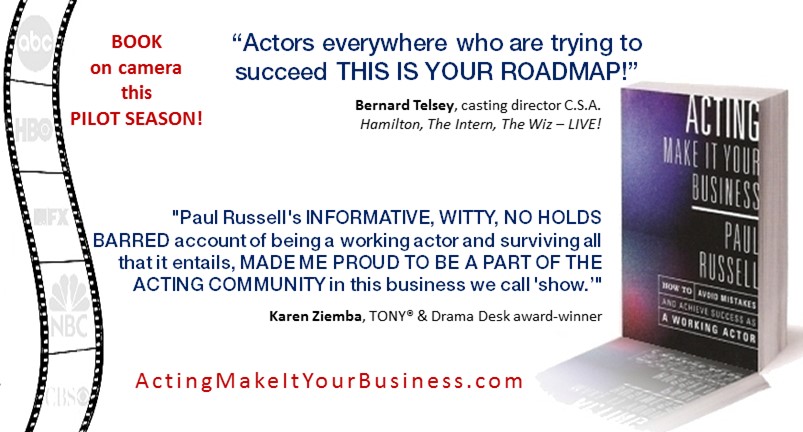
“Humorous and witty…
Actors everywhere who are trying to succeed in the business, young or old, on stage or on camera, anywhere in the world, take note:
This is your roadmap!”
— BERNARD TELSEY, casting director – CSA
(The Intern, Hamilton, NBC’s The Wiz – LIVE!, Wicked)
“All the right questions asked and answered…
and with a generous portion of good humor.”
— SUZANNE RYAN, casting director, CSA
(Law & Order, Unforgettable)
“I love this book!
Paul’s book tells you what you don’t want to hear but really need to know
EVERY actor should read this book!”
— DIANE RILEY, Senior Legit Talent Agent
Harden-Curtis & Associates
“Paul’s book made me proud to be a part of this community we call ‘show!'”
— KAREN ZIEMBA, TONY & Drama Desk Award Winning Actress
“Paul Russell’s words are not only blunt & accurate they zero in on all the questions every actor wants to know but is afraid to ask!”
— KEN MELAMED, Talent Agency Partner
Bret Adams, Ltd.
“I had my Business of Acting, BFA Seniors, class do book reports on a variety of “business of acting” books and ACTING: Make It Your Business came out a clear winner—considered to be essential for their bookshelves!
— Dr. NINA LeNOIR,
Dept. Chair – Dept. of Thtr.
Chapman University
Get smarter on the business of acting from legendary Hollywood & Broadway actors and talent agents in a casting director Paul Russell’s Best-Selling Book ACTING: Make It Your Business!
Paul Russell’s career as a casting director, director, acting teacher and former actor has spanned over thirty years. He has worked on projects for major film studios, television networks, and Broadway. Paul has taught the business of acting and audition technique at NYU and has spoken at universities including Yale, Temple and the University of the Arts. He is the author of ACTING: Make It Your Business – How to Avoid Mistakes and Achieve Success as a Working Actor. For more information, please visit www.PaulRussell.net.




 Answers for Actors
You must be logged in to post a comment.