
We Don’t Fall in Love With Artificial
— A Manifesto for the Human in the Age of Synthetic Storytelling
“Oh, I just love them!
Aren’t they both wonderful in everything they do?”
Two friends, chatting over coffee, might be talking about Julia Roberts, Meryl Streep, Tom Hanks — actors whose names carry warmth, history, and trust. We know them not just for their performances, but for their humanity: their stumbles, their resilience, their laughter, the way time etches itself into their work.
We love Julia Roberts not just because of her laugh on screen, but because it feels like hers — idiosyncratic, slightly unpolished, impossible to replicate. We love Tom Hanks not because he plays “everyman” perfectly, but because his particular humanity makes us believe him.
Truth: we don’t fall in love with perfection. We fall in love with the authentic.
The Threat: Tilly Norwood & Particle6
Now imagine the same conversation in a world where the “them” is not about a living, breathing person — but an AI-generated actor. A synthetic, digital human-like form designed by code in a lab, programmed for flawlessness, executing pathos at the click of a keyboard.
We can conjure an AI actor who laughs like Julia, commands authority like Streep, or exudes empathy like Hanks. To our eyes and ears, the differences between authentic and artificial blur. But beneath the surface, there is a hollowness.
The “performance” has no lived experience: no childhood memory, no heartbreak, no human carrying decades of history.
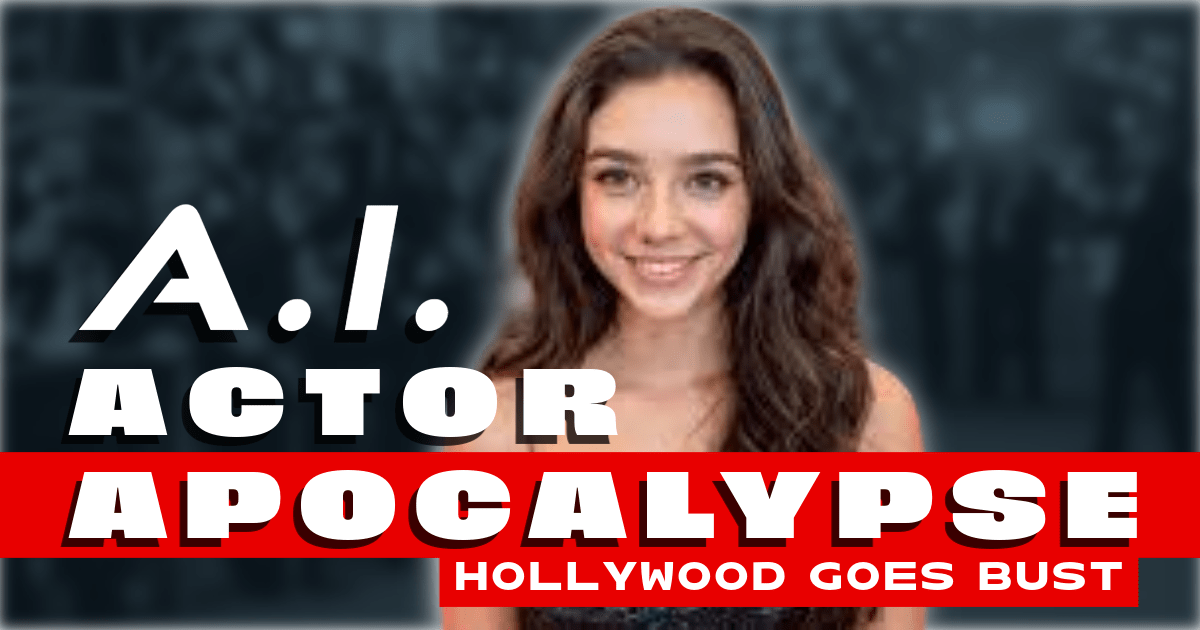
Instead, “them” (it) is Tilly Norwood, an AI-generated “actress,” created by Particle6 Studios and its virtual-talent factory, Xicoia.
Particle6 and Xicoia have already seeded Tilly across TikTok, Instagram, and YouTube — a carefully engineered avatar designed to be “castable, directable, available on demand.” The next headline: she will be the first AI model signed by a Hollywood agency.
The sales pitch: She’ll never age, never demand pay parity, never need a break. Her directors will face no scheduling nightmares, no on-set disagreements.
This is not some “what if” scenario. This is happening. Studios are taking the bait. Agencies smell commission checks. Journalists frame it as innovation.
But peel back the hype and the cracks show:
- The uncanny valley remains. She moves, but with the eerie dissonance of something that almost passes as real.
- The “signing” is a publicity stunt, normalizing the idea that an algorithm deserves a place on the same rosters as living artists.
- Once entrenched, this “experiment” becomes precedent — quietly, irreversibly.
What We Stand to Lose
Remove the living actor and the collapse doesn’t stop there. The loss ripples:
- Actors: the heartbeat of story, replaced by motion-capture shells and synthetic faces.
- Designers, makeup, and wardrobe: no longer needed if costumes are rendered in code.
- Crew and craftspeople: grips, lighting teams, carpenters, scenic artists, craft services — entire professions vanish.
- Casting directors and agents: bypassed by machine-generated “talent.”
- Directors and writers: reduced to prompters and data wranglers.
“The entire ecosystem — from truck drivers to wig makers — is tied to the human presence of performers. Strip that out, and the scaffolding collapses.”
This isn’t just about actors. It’s about an industry gutted at its core.
When AI Mimics the Soul
I’ve lived this terror personally.
I wrote Wicked Journeys — a story seeded in my life: a 19-year-old actor with HIV drifting between theater, love, loss. It carried me from 2002 to 2016 when a publisher expressed interest in bringing my first novel to the public.
Recently, I fed its premise into AI: “Write the story.” What came back was a hollow ghost. The form was there. My voice and heart? Gone.
“The AI imitated the journey but the humor, soul, and relationships of the characters didn’t have the energy and drive to carry the story.”
AI technology can mimic creativity but fails to imagine organically. Without the wonder of imagination, there is no heart, no life.
The Questions That Haunt
- If every performance can be synthesized, what remains for human artists?
- Will we be reduced to administrators of our own erasure?
- How do we feed ourselves when our livelihoods are replaced by algorithms?
- What kind of world do we leave behind when all art is fabricated illusion?
“These questions are not philosophy. They are survival.”
Resistance: What Must Be Done
If this feels like a fight for existence, that’s because it is. Resistance means refusing to normalize machine actors as legitimate peers.
- Name the threat: Call out AI “talent” as simulations, not artists. Never allow their framing to equalize human and machine.
- Union fortification: SAG-AFTRA, IATSE, DGA, WGA — every contract must explicitly ban synthetic “talent” from replacing human labor.
- Policy and law: Demand legislation requiring clear labeling of AI-generated media. Push for compensation when AI uses our likeness, voice, or work as training data.
- Audience awareness: Teach the public to question what they see. To understand that art without humanity is product, not story.
- Collective refusal: Creatives must stand united in declining to feed these systems our work. The more we train them, the more we accelerate our own disappearance.
Resilience: How We Reclaim the Future
Resistance alone is not enough. We need resilience — a blueprint for what survives:
- Reinvest in the live: Theater, concerts, site-specific performance — the experiences no AI can replicate. Presence becomes protest.
- Build human-first studios: Independent companies committed to hiring flesh-and-blood actors, crew, designers. Create an ecosystem outside corporate adoption.
- Educate audiences: Lead campaigns that showcase the raw, messy, irreplaceable beauty of human work.
- Hybrid on our terms: Use AI as a tool, not a replacement — a lighting match, not the fire. Harness it for scheduling, budgeting, research — but keep the soul human.
- International solidarity: Connect with creators globally. What starts in Hollywood echoes everywhere. This is a fight for art, not geography.
“Resilience means not just surviving — but reclaiming the ground, redefining the value of humanity in art.”
The Call
This is not about nostalgia. This is about survival.
If we allow corporations to normalize avatars like Tilly Norwood as the “future of acting,” then acting itself dies. Along with it: the crews, the designers, the artists, the voices.
Art becomes just another supply chain. We become just another audience for hallucinations.
“We must resist. We must build resilience. We must say — loudly, without hesitation: We don’t fall in love with replicas. We fall in love with the real.”
Because once the human is gone from art, the world doesn’t just lose entertainment. It loses its soul.
About Paul
Paul Russell’s career in the entertainment industry spans over forty years as an award-winning casting director and stage director. He has cast for 20th Century Fox, HBO, Broadway, and major regional theaters.
A frequent guest artist at university BFA and MFA actor training programs, Paul also teaches private master classes to actors worldwide.
He is the author of the expanded Second Edition of ACTING: Make It Your Business – How to Avoid Mistakes and Achieve Success as a Working Actor.


 Answers for Actors
You must be logged in to post a comment.